 By
By Seborrheic keratosis is one of the most common benign skin growths found in middle-aged and older adults. These growths can appear as rough, waxy, scaly, or “stuck-on” patches and may range in color from light tan to dark brown or even black. Although seborrheic keratoses are generally harmless, they can become more noticeable, numerous, or irritated as the skin ages.
Understanding seborrheic keratosis in elderly people is important because older skin may develop many different types of spots and growths at the same time. Sun-related changes, age spots, Actinic Keratosis, moles, and Seborrheic Keratosis vs Skin Cancer can sometimes resemble seborrheic keratosis. For this reason, a new or changing growth should not automatically be assumed to be harmless.
What Is Seborrheic Keratosis?
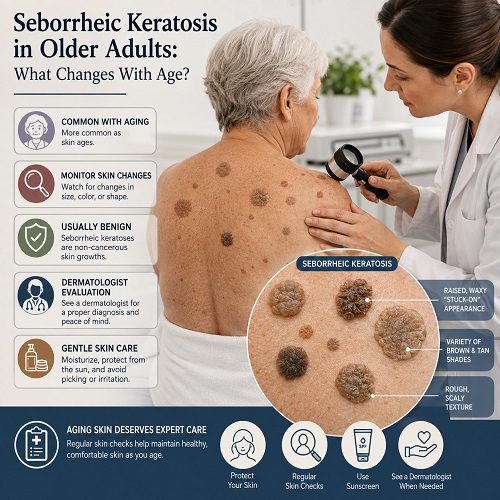
Seborrheic keratosis is a noncancerous skin growth that commonly develops during adulthood and becomes increasingly common with age. Dermatologists often describe these growths as having a “stuck-on” appearance. They may be flat or raised, smooth or rough, and can vary considerably in size and color.
Seborrheic keratoses commonly occur on the chest, back, head, neck, and other areas of the skin. They can develop on both covered and sun-exposed areas, although the exact cause is not fully understood.
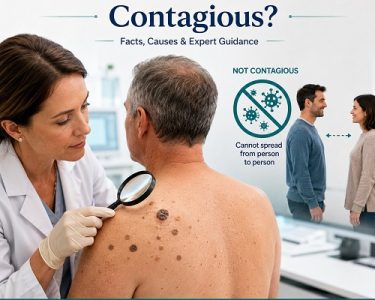
Importantly, seborrheic keratoses are not contagious and do not spread from person to person. Having more lesions over the years usually reflects the tendency for additional growths to develop with aging rather than an infection spreading across the skin.
Why Does Seborrheic Keratosis Become More Common With Age?
Age is one of the strongest associations with seborrheic keratosis. The American Academy of Dermatology notes that most people develop these growths during middle age or later, and their number tends to increase with age. DermNet reports that seborrheic keratoses are extremely common in people over 60.
The precise cause remains unknown. Researchers have identified genetic changes within seborrheic keratoses, and family tendency appears to play a role. Sun exposure may also contribute in some cases, although seborrheic keratoses can develop on areas that are normally covered.
Therefore, aging should be viewed as an important risk factor rather than a single direct cause.
How Seborrheic Keratosis May Change in Older Adults
One of the most noticeable changes with age is the number of seborrheic keratoses a person develops. Someone who had only a few lesions earlier in life may gradually develop many more.
Individual growths can also change in appearance. A seborrheic keratosis may become:
- Thicker or more raised
- Rougher or more scaly
- Darker or lighter
- Larger over time
- More noticeable because surrounding skin becomes thinner
- Irritated by clothing, jewelry, shaving, or friction
These changes do not automatically mean that the growth has become cancerous. Seborrheic keratoses naturally have a wide variety of appearances. However, a significant change in a single lesion deserves attention, particularly when it is different from a person’s other seborrheic keratoses.
Seborrheic Keratosis in Elderly Skin Can Look More Noticeable
Aging skin undergoes many normal changes. It generally becomes thinner, drier, and more fragile, while pigmentation and texture can become uneven.
Because of these changes, existing seborrheic keratoses may appear more prominent. A growth that was previously easy to overlook may become more obvious as the surrounding skin changes.
Older adults may also develop several different types of pigmented or scaly lesions. Solar lentigines, commonly called age spots, are frequent on sun-exposed skin. Actinic keratoses can also occur on chronically sun-damaged skin and require medical attention because they are precancerous lesions.
This is one reason it is important not to diagnose every new brown or rough spot as seborrheic keratosis.
Are Seborrheic Keratoses Dangerous?
In most cases, seborrheic keratoses are harmless and do not require treatment. They are benign growths rather than skin cancers.
However, their appearance can sometimes overlap with skin cancers or precancerous lesions. A dermatologist may therefore recommend an examination when a lesion looks unusual or has changed significantly.
According to the American Academy of Dermatology, a dermatologist can often diagnose seborrheic keratosis by examining the growth. If the lesion looks suspicious, it may be removed or sampled and examined under a microscope to determine whether skin cancer is present.
This distinction becomes particularly important in older adults because the overall number of age-related skin lesions increases over time.
Warning Signs Older Adults Should Not Ignore
Most seborrheic keratoses are stable or change gradually. A lesion that behaves differently from the others should be evaluated.
See a dermatologist if a growth:
- Grows rapidly
- Begins bleeding without an obvious cause
- Becomes persistently painful
- Develops significant or persistent itching
- Changes substantially in color
- Becomes unusually dark or black
- Looks significantly different from your other seborrheic keratoses
- Develops a persistent sore or ulcerated area
- Appears suddenly along with many other unusual growths
The AAD specifically recommends medical evaluation when a suspected seborrheic keratosis grows quickly, turns black, itches, bleeds, or looks different from a typical lesion.
These signs do not necessarily mean cancer is present. They simply mean that the lesion deserves a professional assessment.
Seborrheic Keratosis vs Skin Cancer
One of the biggest concerns about seborrheic keratosis in elderly patients is whether a growth could actually be skin cancer.
Seborrheic keratoses can sometimes resemble melanoma, basal cell carcinoma, squamous cell carcinoma, or other skin lesions. Color alone cannot reliably distinguish them.
A typical seborrheic keratosis may have a waxy, rough, or warty surface and often appears as though it has been placed or “stuck” onto the skin. However, atypical lesions may be more difficult to identify.
Melanoma, for example, can sometimes appear as a dark or irregular growth. Basal cell and squamous cell carcinomas can also develop as changing, scaly, crusted, or bleeding lesions.
For this reason, older adults should avoid relying on photographs or Natural Remedies for Seborrheic Keratosis to determine whether a suspicious lesion is harmless.
Can Older Adults Develop New Seborrheic Keratoses?
Yes. New seborrheic keratoses can appear throughout adulthood, and the number of lesions commonly increases with age. This can make it seem as though the condition is “spreading.”
However, seborrheic keratoses are not contagious. New growths represent the development of additional lesions rather than infection spreading from one area to another.
If many new lesions suddenly appear over a short period, however, it is sensible to discuss the change with a healthcare professional rather than assuming they are all seborrheic keratoses.
Do Seborrheic Keratoses Need Treatment?
Usually, no treatment is necessary if a seborrheic keratosis has been correctly diagnosed and is not causing problems.
Seborrheic Keratosis Treatment Options may be considered when a lesion:
- Becomes Irritated Seborrheic Keratosis
- Catches on clothing
- Bleeds because of repeated friction
- Seborrheic Keratosis Causes discomfort
- Is cosmetically bothersome
- Needs removal because its appearance is uncertain
Dermatologists can use several methods to remove seborrheic keratoses, including Cryotherapy for Seborrheic Keratosis, curettage, electrosurgery, and certain types of shave removal. The most appropriate option depends on the lesion and the patient’s individual circumstances.
Older adults may need particularly careful consideration before a procedure because skin can become more fragile with age and healing may vary depending on overall health, medications, and the location of the lesion.
What Changes With Age During Seborrheic Keratosis Removal?
Removal of a seborrheic keratosis is generally straightforward when performed by a qualified healthcare professional. However, older skin may respond differently to treatment.
For example, pigmentation changes can sometimes occur after removal. The treated area may temporarily or permanently look lighter than the surrounding skin. This consideration can be particularly important for people with darker skin tones.
A dermatologist can discuss the potential benefits and risks before treatment.
If a lesion has not been confidently diagnosed, removal may also provide tissue for microscopic examination. This can help distinguish a benign seborrheic keratosis from another type of growth.
Gentle Skin Care for Older Adults
Although skincare cannot reliably prevent seborrheic keratoses, gentle skin care can help protect aging skin from irritation.
Older adults can consider:
- Using a mild cleanser
- Moisturizing regularly
- Avoiding unnecessary scratching or picking
- Wearing comfortable clothing that does not repeatedly rub raised lesions
- Protecting exposed skin from excessive ultraviolet exposure
- Monitoring existing growths for noticeable changes
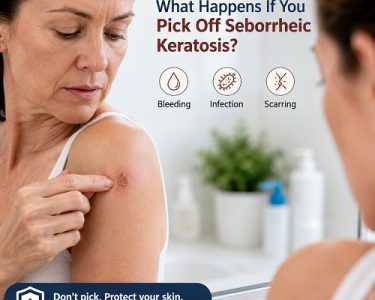
Avoid attempting to cut, scrape, burn, or chemically remove a seborrheic keratosis at home care. The American Academy of Dermatology warns that self-removal can cause complications such as infection and may also delay diagnosis of a lesion that is actually something else.
Does Sun Exposure Affect Seborrheic Keratosis?
The relationship between ultraviolet exposure and seborrheic keratosis is not completely understood. Some research suggests that Seborrheic Keratosis Sun Exposure may play a role, while the lesions can also develop on covered areas.
Regardless, sun protection remains an important part of healthy aging skin care.
Older adults can protect their skin by seeking shade, wearing protective clothing, and using appropriate broad-spectrum sunscreen on exposed areas. Sun protection also helps reduce cumulative ultraviolet damage, which is associated with other age-related skin changes and precancerous lesions such as actinic keratoses.
When Should an Older Adult See a Dermatologist?
Routine awareness of skin changes is useful at any age, but it becomes especially important as the number of skin growths increases.
An older adult should consider professional evaluation when a lesion is new and unusual, changes rapidly, bleeds, becomes painful, develops a persistent sore, or looks substantially different from other established seborrheic keratoses.
People who have difficulty seeing areas such as the back or scalp may also benefit from assistance from a family member or caregiver when checking for noticeable changes.
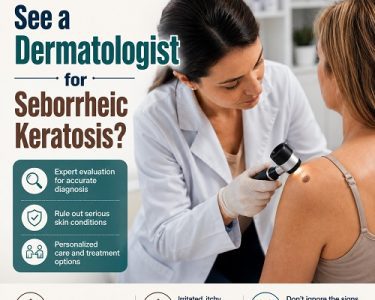
A dermatologist can determine whether a growth has the typical characteristics of seborrheic keratosis or whether further examination is necessary.
The Importance of Not Assuming Every Age Spot Is Seborrheic Keratosis
A common mistake is to treat all brown or rough skin growths in older adults as “age spots.” Several conditions can produce similar-looking lesions.
Seborrheic keratoses, solar lentigines, actinic keratoses, moles, and certain skin cancers may all occur in older adults. Their appearance can overlap, especially when lesions are small or heavily pigmented.
Actinic keratosis is particularly important to recognize because it develops on sun-damaged skin and is considered precancerous. It often appears as a rough, scaly spot rather than the waxy or stuck-on appearance commonly associated with seborrheic keratosis.
When there is uncertainty, professional examination is safer than self-diagnosis.
Frequently Asked Questions
Is seborrheic keratosis common in elderly people?
Yes. Seborrheic keratoses become increasingly common with age. DermNet notes that they are extremely common in adults over 60, while the American Academy of Dermatology states that their number tends to increase as people age.
Can seborrheic keratoses become cancerous?
Seborrheic keratoses are benign growths. However, a lesion that looks like seborrheic keratosis can sometimes actually be another type of skin growth, including skin cancer. A changing or unusual lesion should therefore be examined by a dermatologist.
Why are my seborrheic keratoses getting darker?
Seborrheic keratoses can naturally vary in color, including shades of brown and black. However, a lesion that suddenly becomes very dark, particularly if it also changes shape, grows rapidly, bleeds, or looks different from your other lesions, should be checked by a dermatologist.
Can elderly people remove seborrheic keratoses at home?
Self-removal is not recommended. Cutting, scraping, burning, or applying unapproved substances can cause injury or infection and may interfere with the diagnosis of a suspicious lesion.
Do seborrheic keratoses go away on their own?
They usually persist, although individual lesions may occasionally disappear. If a lesion changes unexpectedly, it is better to have it evaluated rather than assuming that a change means it is naturally disappearing.
Final Thoughts
Seborrheic keratosis in elderly people is extremely common and usually harmless. As the skin ages, individuals may develop more lesions, and existing growths can become thicker, darker, rougher, or more noticeable.
The key is knowing what is typical for your own skin. A stable, previously diagnosed seborrheic keratosis usually does not require treatment. However, a rapidly changing, bleeding, painful, unusually dark, or otherwise unusual growth deserves professional evaluation.
Older adults should also remember that not every brown, rough, or raised spot is a seborrheic keratosis. Because several benign, precancerous, and cancerous skin lesions can look similar, diagnosis by a qualified healthcare professional is the safest approach.
With regular skin awareness, gentle skincare, sun protection, and timely dermatological evaluation of suspicious changes, older adults can better protect their skin while avoiding unnecessary treatment of harmless seborrheic keratoses.