 By
By Noticing a new growth on your skin can be surprising, especially when it seems to appear almost overnight. A person may look at their shoulder, back, chest, neck, or face and suddenly notice a brown, tan, or dark raised spot that was not obvious before. This can lead to an important question: Can seborrheic keratosis appear suddenly?
Seborrheic keratoses are common, noncancerous skin growths that become more frequent with age. Although they may seem to develop very quickly, many do not actually form completely overnight. Instead, a growth may have been developing gradually and only become noticeable once it reached a certain size, thickness, or color.
A sudden seborrheic keratosis can therefore refer to a lesion that appears to have developed rapidly or one that a person has only recently noticed. Understanding how these growths develop can help you distinguish ordinary changes from skin changes that deserve professional evaluation.
What is Seborrheic Keratosis?
Seborrheic keratosis is a common benign growth of the skin. It can occur almost anywhere on the body, although it is particularly common on areas such as the chest, back, abdomen, shoulders, neck, and face.
These growths can vary considerably in appearance. Some are small and flat, while others become thick, raised, and rough. Their color may range from pale tan to brown, dark brown, or nearly black.
A typical seborrheic keratosis may have a characteristic “stuck-on” appearance. Its surface can look waxy, scaly, rough, or slightly crusty.
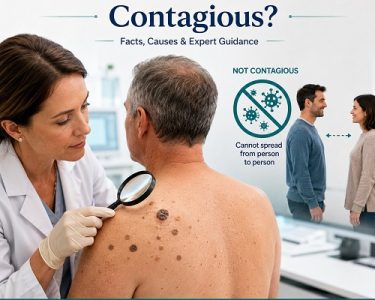
Despite their sometimes dramatic appearance, seborrheic keratoses are generally harmless. They are not contagious and are not caused by poor hygiene.
However, because some skin cancers can resemble seborrheic keratoses, a new or changing lesion should not automatically be assumed to be benign.
Can Seborrheic Keratosis Really Appear Suddenly?
Yes, a seborrheic keratosis can seem to appear suddenly, but there are several possible explanations for this.
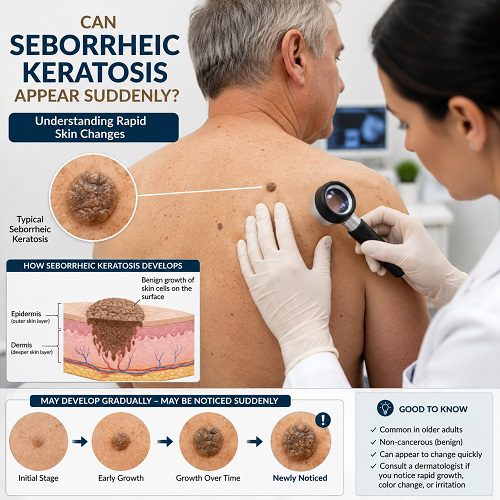
In many cases, the growth was developing before the person noticed it. Seborrheic keratoses can begin as subtle, flat, lightly colored areas that are difficult to see. Over time, they may become more raised, darker, or more textured.
A person may suddenly notice the lesion because:
- It has become larger.
- Its color has become more noticeable.
- The surface has become thicker or rougher.
- It has become irritated by clothing.
- It is located somewhere that was previously difficult to see.
- Someone else noticed it first.
- The person has recently started checking their skin more carefully.
Therefore, what looks like a sudden seborrheic keratosis may actually be a pre-existing lesion that has become more visible.
Why Can a Seborrheic Keratosis Seem to Grow Quickly?
Seborrheic keratoses can change in size and thickness over time. Some remain relatively stable, while others gradually become more prominent.
The exact reason some individuals develop numerous seborrheic keratoses while others develop only a few is not completely understood. Age is one of the strongest associations. They are uncommon seborrheic keratosis in children and young adults but become increasingly common in middle-aged and older adults.
Genetic factors may also influence a person’s tendency to develop these growths. Some people appear to develop multiple lesions within the same family.
A lesion that suddenly becomes noticeable does not necessarily mean that something dangerous is happening. Nevertheless, rapid growth or significant change should be evaluated rather than ignored, particularly if the Seborrheic Keratosis diagnosis has never been confirmed.
What Does a New Seborrheic Keratosis Look Like?
Seborrheic keratoses have many appearances, which can make them difficult to identify without professional experience.
Common characteristics include:
- A round or oval shape
- A well-defined border
- A raised or slightly elevated surface
- Tan, brown, gray, or darker coloration
- A waxy or rough texture
- A “stuck-on” appearance
- Mild scaling or crusting
- Variable thickness
Some lesions are only a few millimeters across, while others can become much larger.
They may occur as a single growth or as multiple lesions scattered across different parts of the body.
Because their appearance can overlap with other skin conditions, visual inspection alone may not always be enough to establish a diagnosis.
Why Do People Notice Them All of a Sudden?
One of the most important points about sudden skin changes is that visibility and development are not always the same thing.
For example, a small seborrheic keratosis may initially blend into the surrounding skin. If it gradually becomes darker or thicker, it may suddenly catch your attention.
The same thing can happen when a lesion is located on the back or scalp. You may not notice it until a family member, hairstylist, or healthcare professional points it out.
Lighting can also make a difference. A skin growth may be much easier to see under bright bathroom lighting than in normal indoor conditions.
This is why the phrase “it appeared overnight” does not necessarily mean that the entire growth formed within one night.
Can Seborrheic Keratosis Become Dark Suddenly?
Seborrheic keratoses can range from light tan to dark brown or nearly black. Some may become darker over time, and irritation can sometimes alter their appearance.
However, a new dark or rapidly changing lesion should be assessed by a dermatologist, particularly if you are unsure whether it is actually a seborrheic keratosis.
Melanoma and other forms of skin cancer can sometimes resemble benign growths. A lesion that changes in color, shape, size, or structure deserves attention.
It is safer to have an uncertain lesion examined than to assume that every new dark growth is a seborrheic keratosis.
When Is a Sudden Seborrheic Keratosis Concerning?
Most seborrheic keratoses are harmless. However, certain changes warrant professional evaluation.
Contact a dermatologist if a new growth:
- Changes rapidly in size.
- Develops several different colors.
- Has an irregular or poorly defined border.
- Bleeds without an obvious reason.
- Develops persistent ulceration.
- Becomes painful or unusually tender.
- Itches persistently or becomes repeatedly irritated.
- Looks significantly different from your other skin growths.
- Appears very suddenly and you are uncertain what it is.
- Continues changing over a short period.
These signs do not automatically mean that the lesion is cancerous. Irritation and other benign skin conditions can produce some of the same seborrheic keratosis symptoms. The purpose of an examination is to determine what the growth actually represents.
Seborrheic Keratosis vs. Skin Cancer
One reason people become concerned about a sudden seborrheic keratosis is that certain skin cancers can look similar to benign lesions.
Seborrheic keratoses can sometimes be dark, irregular-looking, crusty, or thick. These characteristics can overlap with features seen in certain skin cancers.
This is particularly important when a lesion is new or changing.
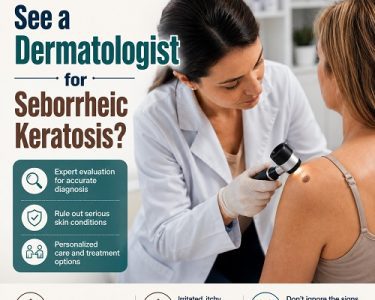
A dermatologist may examine the lesion using a dermatoscope, which provides magnification and additional visual information. If the diagnosis remains uncertain, the doctor may recommend removing part or all of the lesion for laboratory examination.
It is important not to diagnose a suspicious skin growth based solely on photographs or online descriptions.
Does Sudden Appearance Mean Seborrheic Keratosis Is Dangerous?
No. The fact that a lesion appears suddenly does not automatically mean that it is Seborrheic Keratosis dangerous.
Many benign skin growths become noticeable unexpectedly. A person may simply have missed a slowly developing lesion until it became large enough or dark enough to attract attention.
At the same time, “sudden” should not be used as proof that a lesion is harmless.
The safest approach is to consider the entire picture: appearance, location, growth pattern, symptoms, personal risk factors, and whether the lesion has been examined before.
If a lesion is new and unusual, getting an accurate diagnosis is more useful than trying to determine its identity based solely on how quickly you noticed it.
Can Seborrheic Keratoses Multiply Suddenly?
Some people develop multiple seborrheic keratoses over time. It may seem as though several have appeared at once, particularly when a person begins examining their skin closely.
Age and genetic tendency are associated with developing multiple lesions. New growths may continue to appear as a person gets older.
If numerous lesions suddenly develop over a relatively short period, however, it is worth discussing the change with a healthcare professional.
A sudden increase in skin growths does not necessarily indicate a serious condition, but unusual or widespread changes should be assessed in context.
What Happens During a Dermatology Examination?
A dermatologist will generally begin by asking when you first noticed the growth and whether it has changed.
They may examine:
- Color
- Size
- Shape
- Border
- Surface texture
- Thickness
- Location
- Changes over time
A dermatoscope may be used to examine structures that are not easily visible to the naked eye.
If the lesion has typical characteristics of seborrheic keratosis, further testing may not always be necessary. If there is uncertainty, the dermatologist may recommend a biopsy or removal.
This is particularly important for a lesion that is rapidly changing or does not have the typical appearance of seborrheic keratosis.
Should You Remove a Sudden Seborrheic Keratosis?
A seborrheic keratosis generally does not need treatment simply because it exists. Removal may be considered if it becomes irritated Seborrheic Keratosis, repeatedly catches on clothing or jewelry, bleeds because of friction, or causes cosmetic concerns.
Common professional Seborrheic Keratosis Removal approaches can include Cryotherapy for Seborrheic Keratosis, curettage, shave removal, or other techniques selected according to the lesion’s location and characteristics.
However, a person should not attempt to cut, scrape, burn, or chemically remove an unidentified skin growth at home.
Trying to remove a lesion before obtaining a diagnosis can cause infection, scarring, bleeding, and potentially delay appropriate evaluation.
What Can You Do If You Notice a New Skin Growth?
If you notice what appears to be a sudden seborrheic keratosis, start by observing it rather than immediately attempting to remove it.
You can:
- Take a clear photograph for comparison.
- Note approximately when you first noticed it.
- Monitor changes in size, color, shape, or texture.
- Avoid scratching or picking it.
- Arrange a dermatology appointment if it is new, unusual, or changing.
Taking photographs can be particularly helpful because it provides a visual record of changes over time.
However, monitoring should not replace professional evaluation when a lesion appears suspicious.
Seborrheic Keratosis Treatment Options
Seborrheic Keratosis Treatment Options can help manage raised, rough, or irritated skin growths that commonly develop with age. Seborrheic keratoses are usually benign and do not require treatment unless they cause discomfort, become irritated, bleed, or create cosmetic concerns.
A dermatologist may recommend several professional treatment methods. Cryotherapy uses liquid nitrogen to freeze the growth, while curettage involves gently scraping the lesion from the skin. In some cases, shave removal or other dermatological procedures may be recommended depending on the lesion’s size, thickness, and location. Professional evaluation is important before treatment because some skin cancers can resemble seborrheic keratosis.
For people interested in Natural Support for Seborrheic Keratosis, gentle skin care can help maintain healthy surrounding skin. Keeping the area moisturized, avoiding scratching or picking, and protecting exposed skin from excessive sun exposure are practical supportive measures. However, there is limited scientific evidence that Natural Remedies for Seborrheic Keratosis can safely remove established seborrheic keratoses.
Avoid attempting to cut, burn, or chemically remove a growth at home, as this can cause bleeding, infection, or scarring. If a lesion changes rapidly, becomes painful, bleeds, or develops unusual colors or borders, consult a dermatologist for proper diagnosis and treatment.
The best treatment depends on the individual lesion and the person’s needs, so professional guidance is recommended.
Frequently Asked Questions
Can a seborrheic keratosis appear overnight?
It can appear to do so, but most likely the lesion was developing before it became noticeable. Changes in size, thickness, color, or surface texture can make an existing lesion suddenly more visible.
Can seborrheic keratosis grow quickly?
Some seborrheic keratoses can become more noticeable over time. However, a lesion that appears to grow rapidly should be evaluated, especially if it has other unusual characteristics.
Is a sudden seborrheic keratosis cancer?
Seborrheic keratosis itself is a benign skin growth and is not skin cancer. However, a new lesion that resembles seborrheic keratosis may occasionally be another type of growth, including skin cancer. A dermatologist can help determine the diagnosis.
Should I worry about a new brown skin growth?
Not necessarily. Many new brown growths are harmless. Nevertheless, a new or changing pigmented lesion should be examined if it looks unusual, changes quickly, bleeds, becomes painful, or otherwise concerns you.
Can seborrheic keratosis change color?
Yes. Seborrheic keratoses can naturally vary in color from light tan to dark brown. However, a significant or unexplained color change should be assessed by a dermatologist.
Final Thoughts
A sudden seborrheic keratosis can be alarming, particularly when a skin growth seems to appear within a short period. In many cases, the lesion has actually been developing gradually and only becomes noticeable after changing in size, thickness, color, or texture.
Seborrheic keratoses are common benign skin growths, especially as people get older. Most do not require treatment unless they become irritated or cause cosmetic concerns.
However, not every new skin growth is a seborrheic keratosis. Rapidly changing, bleeding, painful, unusually dark, irregular, or otherwise suspicious lesions deserve professional assessment.
If you notice a new growth and are unsure what it is, the best approach is not to pick or remove it yourself. Document the change and speak with a qualified dermatologist. An accurate diagnosis can provide reassurance when the lesion is benign and ensure appropriate treatment when further evaluation is necessary.
Remember: a skin growth that seems sudden is not automatically dangerous, but an unexplained or rapidly changing lesion should never be diagnosed solely from appearance.