 By
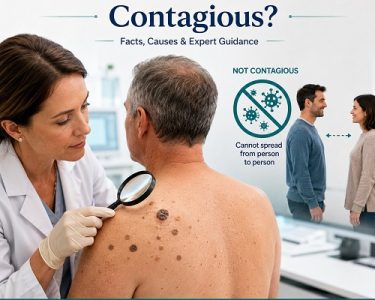
By Finding several new or growing skin lesions can understandably cause concern. When multiple raised, rough, waxy, or brown growths appear on different areas of the body, one possible explanation is multiple seborrheic keratosis. These common skin growths are generally benign, meaning they are not cancerous and do not usually pose a serious health risk.
Seborrheic keratoses can occur almost anywhere on the skin except the palms and soles. They are especially common in middle-aged and Seborrheic Keratosis older adults and some people develop just one or two lesions while others develop dozens over time.
Although multiple seborrheic keratosis is usually harmless, it is important to understand what these growths look like, why they develop, how doctors diagnose them, and when treatment or further evaluation may be necessary.
What is Multiple Seborrheic Keratosis?
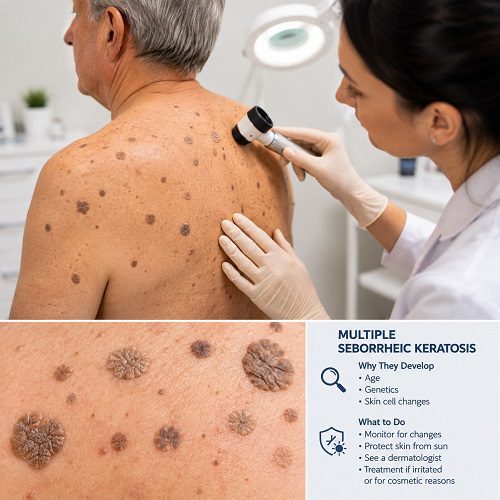
The term multiple seborrheic keratosis refers to the presence of several seborrheic keratoses on the skin. A seborrheic keratosis is a benign growth made up of cells from the outer layer of the skin.
These lesions can vary considerably in appearance. Some are light tan or beige, while others may be brown, dark brown, or nearly black. They can be smooth, slightly raised, rough, or thick with a waxy surface.
One of their most recognizable characteristics is their “stuck-on” appearance. They may look as though something has been placed on top of the skin rather than growing from underneath it.
Multiple lesions may develop on the:
- Back
- Chest
- Abdomen
- Shoulders
- Neck
- Arms
- Face
- Scalp
Most seborrheic keratoses develop slowly and remain stable for long periods. However, new lesions can continue to appear throughout adulthood.
Why Do Multiple Seborrheic Keratoses Develop?
The exact reason some people develop many seborrheic keratoses is not completely understood. However, several factors appear to be associated with their development.
Age
Age is one of the strongest associations. Seborrheic keratoses become increasingly common during middle age and later adulthood.
As skin cells change over time, certain areas may develop localized overgrowths that form seborrheic keratoses. Having one lesion does not necessarily mean that more will appear, but many people gradually develop additional growths.
Genetics and Family History
Genetics may also play an important role. Seborrheic keratoses sometimes occur in several members of the same family.
If parents or other close relatives have numerous seborrheic keratoses, an individual may have a greater tendency to develop them as well.
This does not mean that every person with a family history will develop multiple lesions, but inherited susceptibility may contribute.
Skin Changes Over Time
The skin naturally changes with age. Cell growth, pigmentation, and the structure of the outer skin layer can all change over the years.
Seborrheic keratoses are believed to result from localized proliferation of epidermal cells. Why this happens in particular areas remains uncertain.
Sun Exposure
Sun exposure may be associated with the development of some seborrheic keratoses, although the relationship is not as straightforward as it is with certain other skin conditions.
Seborrheic keratoses can occur on both sun-exposed and covered areas of the body. Therefore, excessive sun exposure should not be considered the sole cause.
Regardless of whether someone has seborrheic keratoses, protecting the skin from excessive ultraviolet exposure remains an important part of general skin care.
What Do Multiple Seborrheic Keratoses Look Like?
Seborrheic keratoses can look different from one person to another and even vary considerably on the same person.
Common features include:
- Round or oval shape
- Clearly defined borders
- Tan, brown, gray, or dark pigmentation
- Raised or slightly elevated surface
- Waxy or rough texture
- “Stuck-on” appearance
- Gradual enlargement
- Scaling or crusting on the surface
Some lesions may be only a few millimeters across, while others can become much larger.
A person with multiple seborrheic keratosis may have lesions in several colors and sizes at the same time.
Importantly, not every dark or raised skin growth is a seborrheic keratosis. Melanoma, certain types of skin cancer, warts, moles, and other conditions can sometimes resemble these lesions.
Are Multiple Seborrheic Keratoses Dangerous?
In most cases, seborrheic keratoses are benign and do not become skin cancer.
However, an important distinction is that a lesion that resembles seborrheic keratosis may occasionally be something else. This is why a new, unusual, or rapidly changing growth should not automatically be assumed to be harmless.
Seek medical evaluation if a lesion:
- Changes rapidly in size
- Develops an unusual or irregular appearance
- Bleeds without obvious injury
- Becomes persistently painful
- Develops significant ulceration
- Has dramatically changing pigmentation
- Looks very different from your other lesions
- Appears suddenly and continues changing
A dermatologist can determine whether the appearance is consistent with seborrheic keratosis or whether further testing is necessary.
Can Multiple Seborrheic Keratosis Appear Suddenly?
Sometimes people feel that several seborrheic keratoses appeared suddenly. In reality, some lesions may have been small or difficult to notice before becoming more prominent.
Changes in pigmentation, thickness, or surface texture can make an existing lesion easier to see.
However, the sudden appearance of numerous lesions over a relatively short period should be discussed with a healthcare professional, particularly when the lesions have unusual features.
A rare phenomenon known as the Leser-Trélat sign describes the sudden eruption of numerous seborrheic keratosis-like lesions. Although it has historically been associated with internal malignancy, its significance remains controversial, and many eruptions of multiple seborrheic keratoses are not related to cancer.
For this reason, a doctor should evaluate a sudden widespread eruption rather than assuming a specific underlying cause.
How Is Multiple Seborrheic Keratosis Diagnosed?
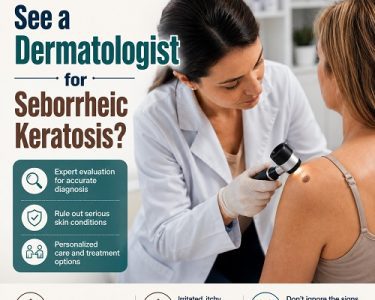
A dermatologist can often identify seborrheic keratosis by examining the skin.
The doctor may assess:
- Color
- Shape
- Surface texture
- Thickness
- Borders
- Distribution
- Changes over time
A handheld dermatoscope may also be used to examine structures beneath the skin surface that are not easily visible to the naked eye.
If a lesion has an atypical appearance, the dermatologist may recommend a biopsy. During a biopsy, a small sample or the entire lesion may be removed and examined under a microscope.
A biopsy can help distinguish seborrheic keratosis from melanoma, basal cell carcinoma, squamous cell carcinoma, or other skin conditions that may look similar.
Do Multiple Seborrheic Keratoses Need Treatment?
Usually, treatment is not medically necessary if the lesions have been correctly diagnosed and are not causing problems.
Treatment may be considered when a seborrheic keratosis:
- Becomes Irritated Seborrheic Keratosis
- Frequently catches on clothing
- Bleeds after repeated friction
- Seborrheic Keratosis Causes itching
- Interferes with shaving
- Becomes inflamed
- Is cosmetically bothersome
Some people also choose Removal for Seborrheic Keratosis because they dislike the appearance of multiple visible lesions.
The appropriate treatment depends on the lesion’s size, thickness, location, appearance, and the patient’s preferences.
Treatment Options for Multiple Seborrheic Keratosis
Cryotherapy
Cryotherapy for Seborrheic Keratosis uses extremely cold temperatures to destroy the targeted skin growth.
Liquid nitrogen is commonly used. The treated area may blister, crust, or become temporarily irritated before healing.
Cryotherapy can be effective for appropriately selected seborrheic keratoses, although more than one treatment may sometimes be necessary.
Curettage
Curettage involves using a medical instrument to scrape the growth from the surface of the skin.
It may be used alone or in combination with another technique. A healthcare professional determines whether curettage is appropriate based on the lesion’s characteristics.
Electrosurgery
Electrosurgery uses electrical energy to destroy the targeted tissue. It may sometimes be combined with curettage.
Because procedures can affect surrounding skin, treatment should be performed by a qualified medical professional.
Shave Removal
A dermatologist may use a blade to remove a raised lesion at the level of the skin.
This approach can be useful for selected lesions and may also allow tissue to be examined when there is diagnostic uncertainty.
Laser Treatment
Certain lasers may be used for some seborrheic keratoses, particularly when appearance is an important concern. Availability and suitability vary depending on the lesion and the provider.
Can Home Remedies Remove Multiple Seborrheic Keratoses?
People with multiple seborrheic keratosis often search for natural remedies or household treatments to remove the lesions.
It is important to be cautious.
Applying acids, concentrated essential oils, irritating substances, or unapproved products to skin growths can cause burns, infection, scarring, or pigmentation changes. More importantly, attempting to destroy an undiagnosed lesion could make it harder to identify a skin cancer.
Gentle skin care may help reduce irritation, but there is no reliable Natural Treatment for Seborrheic Keratosis that can safely replace professional diagnosis and removal when treatment is needed.
If you are interested in natural support for seborrheic keratosis, discuss any topical product or supplement with a qualified healthcare professional before using it, particularly if you have sensitive skin or multiple changing lesions.
How to Care for Skin With Multiple Seborrheic Keratoses
If you have several seborrheic keratoses, simple skin-care measures can reduce irritation.
Avoid Picking or Scratching
Scratching can cause bleeding and increase the risk of secondary infection. If a lesion becomes itchy, try to avoid rubbing it.
Reduce Friction
Loose, comfortable clothing can reduce repeated rubbing against raised lesions.
Keep the Skin Moisturized
A gentle, fragrance-free moisturizer can help maintain the skin barrier and may reduce dryness and irritation around lesions.
Protect Your Skin From the Sun
Use broad-spectrum sunscreen and protective clothing when spending time outdoors. Sun protection is important for overall skin health, even though seborrheic keratoses are not simply caused by sun exposure.
Monitor Changes
If you have numerous lesions, becoming familiar with their normal appearance can make it easier to notice changes.
Taking occasional photographs may help you and your dermatologist compare lesions over time.
Can You Prevent Multiple Seborrheic Keratosis?
There is currently no guaranteed way to prevent seborrheic keratoses.
Age and genetic susceptibility cannot be changed. Because these growths are associated with natural changes in the skin, prevention is not always possible.
Nevertheless, maintaining healthy skin habits remains beneficial. Protecting your skin from excessive ultraviolet exposure, avoiding unnecessary irritation, and scheduling appropriate skin examinations can support overall skin health.
When Should You See a Dermatologist?
You should consider seeing a dermatologist if you develop numerous new lesions, particularly if they appear quickly or look different from your existing seborrheic keratoses.
Professional evaluation is especially important when a lesion:
- Changes quickly
- Has multiple unusual colors
- Becomes painful
- Bleeds repeatedly
- Develops an irregular border
- Becomes ulcerated
- Looks significantly different from your other lesions
A dermatologist can determine whether the growths are typical seborrheic keratoses or whether additional testing is appropriate.
People with many pigmented lesions may also benefit from periodic professional skin examinations, especially if they have other risk factors for skin cancer.
Multiple Seborrheic Keratosis vs. Other Skin Growths
One reason professional diagnosis is valuable is that several skin conditions can resemble seborrheic keratosis.
Moles may be flat or raised and can vary in color. Warts often have a rough surface. Skin tags are typically softer and may hang from the skin. Certain skin cancers can also appear as pigmented, scaly, or raised growths.
Seborrheic keratoses often have a characteristic waxy, well-defined, stuck-on appearance, but appearance alone is not always enough to make a definitive diagnosis.
When there is uncertainty, a dermatologist can use dermoscopy and, when appropriate, biopsy.
Living With Multiple Seborrheic Keratosis
Having many seborrheic keratoses can be frustrating, particularly when lesions are visible on the face, neck, arms, or other exposed areas.
The good news is that typical seborrheic keratoses are benign. They do not usually require treatment simply because they exist.
The most important step is obtaining an accurate diagnosis. Once a dermatologist confirms that the lesions are seborrheic keratoses, you can decide whether treatment is necessary based on symptoms, irritation, appearance, and personal preference.
For people with numerous lesions, treating every growth may not always be practical. A dermatologist can help prioritize lesions that are irritated, frequently traumatized, or diagnostically uncertain.
Final Thoughts
Multiple seborrheic keratosis is a common presentation of a benign skin condition in which a person develops several waxy, rough, raised, or “stuck-on” growths. Age, genetics, and natural changes in the skin appear to play important roles, although the exact cause is not completely understood.
Most seborrheic keratoses are harmless and do not require treatment. However, new or rapidly changing lesions should be evaluated rather than automatically assumed to be seborrheic keratoses.
When treatment is desired or medically appropriate, options such as cryotherapy, curettage, electrosurgery, shave removal, and selected laser procedures may be considered by a dermatologist.
If you notice multiple new skin growths, especially if they are changing, bleeding, painful, or significantly different from your other lesions, professional evaluation is the safest approach. Early assessment can provide reassurance and help ensure that unusual skin growths receive the appropriate diagnosis and care.