
 By
By Actinic keratosis is a common skin condition caused by long-term exposure to ultraviolet (UV) radiation. It often appears as a rough, scaly or crusty patch on areas of skin that receive regular sun exposure, such as the Actinic Keratosis on the Face, Actinic Keratosis on the Ears, Actinic Keratosis on the Scalp, neck, forearms and backs of the hands.
Some actinic keratoses remain harmless for years, while others can develop into squamous cell carcinoma, a type of skin cancer. Because it can sometimes be difficult to distinguish an actinic keratosis from other skin conditions or an early skin cancer, knowing when to see a dermatologist for actinic keratosis is important.
You may not need to panic whenever you notice a rough patch of skin. However, a persistent, changing, bleeding or painful lesion deserves professional attention.
A dermatologist can examine the area, determine whether it looks like actinic keratosis and recommend appropriate treatment or further testing.
What Is Actinic Keratosis?
What Is Actinic Keratosis? Actinic keratosis develops when skin cells become damaged after repeated exposure to UV radiation. The damage usually accumulates over many years, which is why actinic keratosis is particularly common in adults with significant lifetime sun exposure.
A lesion may initially be easier to feel than see. You might notice a rough area when running your fingers over the skin before you can clearly identify a visible patch.
Actinic keratoses can vary in appearance. They may be:
- Rough or sandpaper-like
- Scaly or crusty
- Pink, red, brown or skin-coloured
- Flat or slightly raised
- Small or several centimetres across
- Tender, itchy or occasionally asymptomatic
They commonly develop on sun-exposed areas, although they can occur elsewhere if that skin has received substantial UV exposure.
Having one actinic keratosis may also indicate that the surrounding skin has experienced significant sun damage.
Do You Always Need to See a Dermatologist for Actinic Keratosis?
Not every rough skin patch requires an urgent dermatology appointment. However, it is sensible to have a new or persistent lesion assessed if you are unsure what it is.
A dermatologist for actinic keratosis can assess whether a lesion has the typical characteristics of actinic keratosis or whether another condition needs to be considered.
Professional assessment becomes particularly important when:
- The lesion does not disappear
- It continues to grow
- It becomes thicker
- It repeatedly forms a crust
- It bleeds
- It becomes painful or tender
- Its appearance changes
- You develop several lesions
- A previously treated lesion returns
- You notice a sore that does not heal
- You have a history of skin cancer
These features do not automatically mean that a lesion is cancerous. They simply mean that it deserves proper evaluation.
When Should You Make a Dermatology Appointment?
1. When a Rough Patch Persists
A rough patch that remains for weeks or months should not simply be ignored, particularly if it is located on a sun-exposed area.
Actinic keratoses often persist rather than behaving like temporary irritation or minor skin damage.
If moisturising or avoiding an obvious irritant does not improve the area, arrange an assessment with a healthcare professional.
A dermatologist can examine the lesion and determine whether it is consistent with actinic keratosis or another skin condition.
2. When the Lesion Becomes Thicker
Changes in thickness are worth discussing with a doctor.
An actinic keratosis may initially look like a thin, rough patch but can become thicker or more prominent over time. Increasing thickness does not prove that the lesion has become cancerous, but it can make professional evaluation more important.
Thicker lesions may require treatment, and your dermatologist may decide whether additional investigation is necessary.
3. When an Actinic Keratosis Starts Bleeding
Bleeding is one of the Early Signs of Actinic Keratosis that should prompt medical assessment.
An actinic keratosis can occasionally become irritated or injured, especially when it is located on an exposed area. However, spontaneous or repeated bleeding should not be dismissed.
If a rough patch repeatedly bleeds, crusts or reopens, contact a healthcare professional.
4. When the Area Becomes Painful
Many actinic keratoses do not cause significant symptoms. Some can feel irritated or tender, but new or increasing pain deserves attention.
Pain does not necessarily indicate skin cancer. Nevertheless, when pain occurs alongside growth, thickening, bleeding or persistent crusting, a dermatologist should examine the lesion.
5. When the Lesion Changes
Changes in a skin lesion are an important reason to seek medical advice.
Pay attention to changes such as:
- Increasing size
- Increasing thickness
- New bleeding
- Persistent crusting
- Increasing redness
- New tenderness
- A change in surface texture
- A sore that does not heal
Taking occasional photographs of suspicious areas can help you notice changes over time, although photographs should never replace professional assessment.
Actinic Keratosis Diagnosis: What Happens at the Appointment?
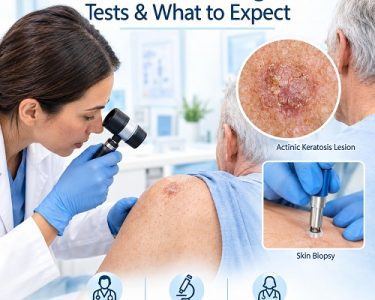
One of the main benefits of seeing a dermatologist for actinic keratosis is that the doctor can examine the lesion using specialised equipment.
Visual Examination
The dermatologist will usually inspect the lesion and the surrounding skin.
They may consider:
- Its colour
- Size
- Texture
- Shape
- Location
- Thickness
- Number of lesions
- Changes over time
The dermatologist may also examine other areas of sun-damaged skin because actinic keratoses can occur in multiple locations.
Dermoscopy
A dermatologist may use a dermatoscope to examine the lesion more closely.
This handheld device provides magnification and illumination, allowing the clinician to identify structures that are difficult to see with the naked eye.
Dermoscopy can help distinguish actinic keratosis from certain other skin lesions.
Skin Biopsy
Sometimes the dermatologist cannot confidently determine the Actinic Keratosis diagnosis from examination alone.
In such cases, a small skin biopsy may be recommended. The clinician removes a small sample of tissue and sends it to a laboratory for microscopic examination.
A biopsy can help determine whether the lesion is:
- Actinic keratosis
- Another benign skin condition
- Squamous cell carcinoma
- Another type of skin lesion
A biopsy does not mean that you definitely have cancer. It is simply a diagnostic procedure used when further information is needed.
What Are Suspicious Skin Lesions?
The phrase suspicious skin lesions refers to skin changes that require closer assessment because their appearance, behaviour or Actinic Keratosis symptoms are unusual.
With actinic keratosis, potentially concerning features include persistent thickening, significant tenderness, repeated bleeding, ulceration, rapid growth or failure to heal.
You should also pay attention to lesions that look noticeably different from other spots on your skin.
If you have several rough patches, it can be tempting to assume that every new lesion is another actinic keratosis. That assumption can delay diagnosis of another condition.
When a new lesion looks different or behaves differently, have it checked rather than diagnosing it yourself.
Can Actinic Keratosis Turn Into Skin Cancer?
Yes. Some actinic keratoses can progress to squamous cell carcinoma.
The risk associated with an individual lesion varies, and many actinic keratoses do not become cancerous. However, actinic keratosis is considered a marker of significant cumulative sun damage.
This is one reason doctors may recommend treating actinic keratoses rather than simply ignoring them.
Squamous cell carcinoma can often be treated successfully, especially when identified early.
Therefore, recognising changes and seeking medical assessment when necessary can play an important role in protecting your skin health.
When Is an Actinic Keratosis More Urgent?
Most actinic keratoses do not represent a medical emergency.
However, you should arrange prompt medical assessment if a lesion:
- Grows quickly
- Becomes significantly thicker
- Bleeds without an obvious cause
- Repeatedly develops a crust
- Becomes increasingly painful
- Forms an open sore
- Does not heal
- Changes noticeably over a short period
If you notice rapid changes or a lesion that appears markedly different from your other actinic keratoses, do not wait indefinitely for it to settle.
What Treatments Might a Dermatologist Recommend?
Treatment depends on the number, location and appearance of lesions, along with your overall skin health.
Possible treatments include:
Cryotherapy
Cryotherapy uses extreme cold to destroy abnormal skin cells. It is commonly used for individual or limited actinic keratoses.
The treated area may become red, swollen or blistered before healing.
Prescription Topical Treatments
Certain prescription creams or gels can treat actinic keratoses across a wider area of sun-damaged skin.
Your dermatologist will select a treatment based on the location, extent of sun damage and your individual circumstances.
Photodynamic Therapy
Photodynamic therapy uses a light-sensitive medication followed by a specific light source to destroy abnormal cells.
It may be useful when multiple lesions occur within an area of sun-damaged skin.
Curettage or Other Procedures
For selected lesions, a dermatologist may remove abnormal tissue using a minor procedure. The method depends on the lesion’s characteristics and whether there is concern about skin cancer.
Your dermatologist can explain why a particular treatment is appropriate.
What If You Have Multiple Actinic Keratoses?
Multiple lesions are common in people with extensive cumulative sun exposure.
If you have several actinic keratoses, a dermatologist may assess the broader area rather than treating only one visible lesion.
This approach can help identify additional areas of sun damage that you may not have noticed yourself.
Your doctor may also discuss measures to reduce further UV exposure, including protective clothing, shade and appropriate sunscreen use.
Should You See a Dermatologist If an Actinic Keratosis Comes Back?
Yes.
Recurrence does not necessarily mean that a lesion has become cancerous. Actinic keratosis can return after treatment, and new lesions may also develop because the surrounding skin has sustained long-term UV damage.
However, a recurrent lesion should be examined, especially if it is thicker, painful, bleeding or changing.
The dermatologist can determine whether the area represents recurrent actinic keratosis or requires further investigation.
What Can You Do While Waiting for Your Appointment?
While waiting for an appointment, avoid picking, scratching or repeatedly irritating the lesion.
Protect the affected skin from additional UV exposure by:
- Seeking shade when possible
- Wearing protective clothing
- Wearing a broad-brimmed hat when appropriate
- Using broad-spectrum sunscreen as directed
- Avoiding intentional tanning
- Avoiding tanning beds
Do not attempt to remove a suspicious lesion yourself.
Over-the-counter products may also irritate certain lesions or alter their appearance, potentially making assessment more difficult.
If the lesion changes significantly before your appointment, contact your healthcare provider.
How Can You Reduce Future Actinic Keratoses?
Preventing additional UV damage is an important part of managing actinic keratosis.
Sun protection should become part of your everyday routine, particularly if you have already developed actinic keratoses.
Useful measures include:
- Use broad-spectrum sunscreen on exposed skin.
- Reapply sunscreen according to the product instructions, particularly after sweating or swimming.
- Wear protective clothing when spending extended periods outdoors.
- Use shade during periods of strong sunlight.
- Wear a wide-brimmed hat to protect the face, ears and scalp.
- Avoid tanning beds.
- Check your skin regularly for new or changing lesions.
Sun protection does not eliminate the risk of actinic keratosis, but it can help reduce additional UV-related damage.
When Should You Seek Immediate Medical Advice?
Actinic keratosis itself is usually not an emergency. However, a rapidly changing or significantly abnormal skin lesion should receive prompt medical attention.
Seek medical assessment if you notice a lesion that rapidly enlarges, repeatedly bleeds, becomes very painful, develops an ulcer or fails to heal.
You should also seek assessment if you are uncertain whether a lesion is an actinic keratosis or another type of skin growth.
It is safer to have a suspicious lesion examined than to assume that it is harmless.
Frequently Asked Questions
Can a GP diagnose actinic keratosis?
Yes. A GP may recognise actinic keratosis during a clinical examination. However, a dermatologist may provide more specialised assessment, particularly when the diagnosis is uncertain or a lesion has concerning features.
Does every actinic keratosis need treatment?
Actinic Keratosis Treatment recommendations vary. A healthcare professional may consider the lesion’s appearance, location, symptoms, number of lesions and risk factors before recommending treatment.
Is actinic keratosis always rough?
No. Although rough or scaly texture is common, some lesions can be subtle and easier to feel than see.
Can actinic keratosis disappear by itself?
Some lesions may become less noticeable or temporarily disappear, but this does not necessarily mean the underlying sun damage has resolved. Persistent or recurrent lesions should be assessed.
Can actinic keratosis become cancer?
Yes. Some actinic keratoses can progress to squamous cell carcinoma. This is why monitoring suspicious changes and obtaining appropriate medical assessment is important.
How often should I have my skin checked?
There is no single schedule that applies to everyone. Your healthcare professional can recommend an appropriate examination frequency based on your skin history, previous lesions and risk factors.
Final Thoughts
Knowing when to see a dermatologist for actinic keratosis can help you deal with suspicious skin changes before they become more difficult to manage.
A rough or scaly patch on sun-exposed skin may be a harmless actinic keratosis, but persistent, thickened, painful, bleeding or changing lesions deserve professional assessment.
Actinic Keratosis diagnosis generally involves a clinical skin examination and, when necessary, dermoscopy or biopsy. A dermatologist can determine whether a lesion looks like actinic keratosis or whether it needs further investigation.
Do not try to diagnose suspicious skin lesions yourself. If a lesion is new, persistent or changing, arrange an appointment with a qualified healthcare professional.
Early assessment does not necessarily mean that something serious is wrong. It simply gives you a better opportunity to identify the cause and receive appropriate treatment.
Medical Disclaimer
This article is intended for general educational purposes and does not replace professional medical advice, diagnosis or treatment. If you have a new, changing, bleeding, painful or non-healing skin lesion, consult a qualified healthcare professional or dermatologist for an appropriate examination.