 By
By Actinic Keratosis on the Scalp is a common skin condition caused primarily by long-term exposure to ultraviolet (UV) radiation from the sun. It often develops on areas that receive frequent sunlight, making the scalp particularly vulnerable in people with thinning hair, receding hairlines or bald scalps.
The condition typically appears as rough, dry or scaly patches on the skin. Some lesions may be easier to feel than to see, especially during the early stages. Although actinic keratosis is not always cancerous, it is considered a precancerous skin condition because some lesions can potentially develop into squamous cell carcinoma, a type of skin cancer.
Recognising scalp changes early and seeking appropriate medical advice can help reduce the risk of complications. This article explains the symptoms, causes, diagnosis and treatment options for actinic keratosis affecting the scalp.
What Is Actinic Keratosis on the Scalp?
What Is Actinic Keratosis on the Scalp? Actinic keratosis, sometimes called solar keratosis, develops when prolonged UV exposure damages skin cells. Over many years, repeated sun exposure can cause abnormal changes within the outer layer of the skin.
When these changes occur on the scalp, they may appear as small rough patches known as scalp actinic keratosis lesions.
The scalp is particularly exposed to sunlight in people who have:
- Male-pattern baldness
- Thinning hair
- A receding hairline
- Naturally sparse hair
- A completely bald scalp
Hair can provide some protection from UV radiation, but areas where the scalp is exposed directly to sunlight remain vulnerable. Years of outdoor activities, occupational sun exposure and inadequate sun protection may contribute to bald scalp sun damage.
Actinic keratosis can occur as a single lesion or multiple patches across the scalp. Some people develop several lesions over time because the surrounding skin may also have experienced significant cumulative sun damage.
What Does Actinic Keratosis on the Scalp Look Like?
Actinic keratosis does not always Look Like the same. Its appearance can vary depending on the person’s skin tone, the degree of sun damage and the stage of the lesion.
Common characteristics include:
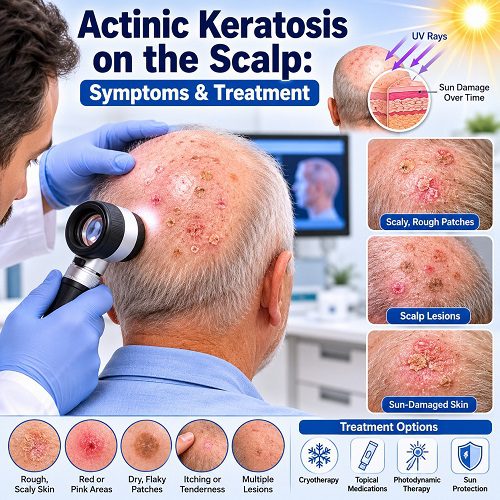
- Rough or sandpaper-like texture
- Dry, flaky or scaly skin
- Small raised patches
- Pink or red areas
- Brown or tan spots
- Skin-coloured rough patches
- Thickened or crusted areas
Some scalp lesions may feel rough when a person runs their fingers over the scalp but may not be immediately visible.
In some cases, an actinic keratosis may temporarily disappear and later return. This does not necessarily mean that the underlying sun damage has resolved.
Because the appearance of suspicious scalp lesions can overlap with other skin conditions, a dermatologist should examine persistent or changing lesions.
Symptoms of Actinic Keratosis on the Scalp
The symptoms of Actinic Keratosis on the Scalp can range from mild roughness to more noticeable scaly patches.
Rough or Scaly Patches
A rough texture is one of the most common signs. The affected area may feel similar to sandpaper.
Many people notice the texture before they notice a visible change in colour.
Dry or Flaky Skin
The lesion may become dry and produce small flakes or scales. It may resemble persistent dry skin that does not improve with normal moisturising.
Red or Pink Areas
Some lesions appear red, pink or slightly inflamed. These areas may become more noticeable after sun exposure.
Thickened Skin
Over time, some actinic keratoses can become thicker and more raised. Thick or hardened lesions should be assessed by a healthcare professional.
Itching or Burning
Some people experience mild itching, burning or tenderness around the affected area.
However, many lesions cause no discomfort at all.
Crusting or Bleeding
A lesion that repeatedly crusts, bleeds or fails to heal should receive medical attention. Although these symptoms do not automatically mean cancer, they require proper assessment.
What Causes Scalp Actinic Keratosis?
The primary cause of scalp actinic keratosis is cumulative exposure to ultraviolet radiation.
UV radiation damages DNA within skin cells. The body can repair some damage, but repeated exposure over many years can overwhelm these repair mechanisms. Abnormal cells may then begin to develop within the skin.
Several factors can increase the risk.
Long-Term Sun Exposure
People who spend significant time outdoors may have a greater risk, particularly if they frequently expose their scalp to direct sunlight.
Occupations and activities associated with prolonged sun exposure include:
- Construction work
- Farming
- Gardening
- Fishing
- Outdoor sports
- Hiking
- Golf
Baldness and Thinning Hair
A bald or thinning scalp receives more direct UV exposure than a scalp covered with dense hair.
This is why bald scalp sun damage is a common concern, particularly in older adults.
Fair Skin
People with lighter skin tones, freckles or a tendency to burn easily may have a higher risk of UV-related skin damage.
However, actinic keratosis can affect people with different skin tones.
Ageing
The risk increases with age because sun damage accumulates gradually over decades.
Previous Sunburns
Repeated or severe sunburns may contribute to long-term skin damage.
Weakened Immune System
People with suppressed immune systems may have an increased risk of developing actinic keratosis and other skin cancers.
Who Is Most at Risk?
Although anyone can develop actinic keratosis certain people face a higher risk.
You may be more vulnerable if you:
- Are over the age of 50
- Have a bald or thinning scalp
- Spend substantial time outdoors
- Have a history of frequent sunburn
- Have fair or sun-sensitive skin
- Have previously developed actinic keratosis
- Have a history of skin cancer
- Have a weakened immune system
Having one or more risk factors does not mean that a person will definitely develop the condition. However, it makes regular skin monitoring and sun protection especially important.
Can Actinic Keratosis on the Scalp Become Cancerous?
Actinic keratosis is considered a precancerous skin condition.
Most individual lesions do not necessarily progress to cancer. However, some can develop into squamous cell carcinoma if abnormal skin cells continue to grow.
It is difficult to predict exactly which lesion may progress. For this reason, doctors often recommend monitoring or treating actinic keratoses.
Seek medical attention if a scalp lesion:
- Grows rapidly
- Becomes significantly thicker
- Bleeds repeatedly
- Develops an ulcer
- Becomes painful
- Changes noticeably in appearance
- Does not heal
Early evaluation is important because skin cancers are generally easier to manage when detected at an early stage.
How Is Actinic Keratosis on the Scalp Diagnosed?
A dermatologist can often identify actinic keratosis through a clinical examination.
The doctor will examine the scalp and look for characteristic Early Signs of Actinic Keratosis of sun damage and abnormal lesions.
Physical Examination
The dermatologist may inspect:
- The scalp
- Forehead
- Face
- Ears
- Neck
- Other sun-exposed areas
People with one actinic keratosis may have additional lesions elsewhere.
Dermatoscopy
A dermatologist may use a dermatoscope, a specialised device that magnifies and illuminates the skin.
This can help the doctor examine structures that are not easily visible to the naked eye.
Skin Biopsy
If a lesion appears suspicious or the diagnosis is uncertain, the doctor may recommend a biopsy.
During this procedure, a small sample of tissue is removed and examined under a microscope.
A biopsy can help distinguish actinic keratosis from other scalp lesions, including skin cancer.
Treatment Options for Actinic Keratosis on the Scalp
Treatment depends on several factors, including:
- The number of lesions
- Their size and thickness
- Their location
- The extent of surrounding sun damage
- The person’s general health
A dermatologist can recommend the most appropriate treatment.
Cryotherapy
Cryotherapy is one of the most commonly used treatments for individual actinic keratosis lesions.
The doctor applies liquid nitrogen to freeze the abnormal cells.
The treated area may become red, blistered or crusted before healing.
Cryotherapy is often useful when only a small number of isolated lesions are present.
Topical Medications
Prescription creams or gels may be used when multiple areas of the scalp contain actinic keratoses.
These treatments can target abnormal cells across a wider area of sun-damaged skin.
Depending on the medication, treatment may cause temporary redness, irritation, crusting or inflammation.
A doctor should provide specific instructions about how and when to use topical treatments.
Photodynamic Therapy
Photodynamic therapy combines a light-sensitive medication with a specific light source.
The medication is applied to the affected skin, and the area is later exposed to controlled light.
This activates the medication and helps destroy abnormal cells.
Photodynamic therapy may be useful for people with multiple actinic keratoses in a concentrated area.
Curettage or Other Procedures
Thicker lesions may require additional treatment methods.
A dermatologist may recommend removing abnormal tissue using specialised procedures. The exact approach depends on the appearance and characteristics of the lesion.
Field Treatment
When a large area of the scalp shows extensive sun damage, doctors may recommend treating the broader affected area rather than focusing only on individual visible lesions.
This approach can help target abnormal cells that may not yet be visible.
Can You Treat Actinic Keratosis at Home?
A person should not attempt to remove suspicious scalp lesions at home.
Cutting, scraping or burning a lesion can cause infection, scarring and delayed diagnosis.
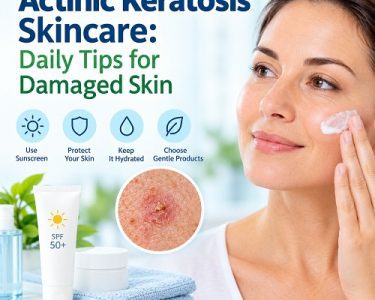
Over-the-counter creams and moisturisers may improve dryness but do not reliably eliminate actinic keratosis.
If you notice persistent rough or scaly scalp lesions, professional evaluation is the safest approach.
Some people are interested in Natural Treatment for Actinic Keratosis. While maintaining healthy skin habits may support general skin comfort, natural remedies should not replace medical diagnosis or evidence-based treatment for potentially precancerous lesions.
How to Protect the Scalp From Further Sun Damage
Prevention plays an important role, particularly for people with thinning hair or baldness.
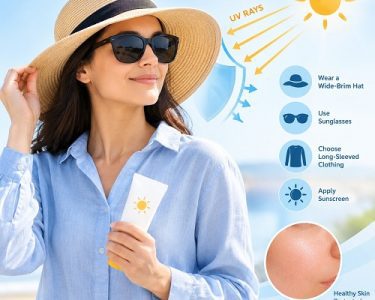
Wear a Hat
A broad-brimmed hat can provide physical protection from direct sunlight.
Choose a hat that covers the scalp, ears and surrounding areas.
Use Sunscreen on Exposed Scalp Areas
Apply broad-spectrum sunscreen to exposed areas of the scalp.
People with thinning hair may benefit from sunscreen products specifically designed for the scalp or lightweight formulations that are easier to apply.
Follow the product instructions regarding reapplication.
Seek Shade
Limit direct sun exposure when UV radiation is particularly intense.
Seek shade during prolonged outdoor activities whenever possible.
Perform Regular Skin Checks
Examine the scalp regularly, particularly if you have a history of actinic keratosis.
A family member, partner or healthcare professional may help inspect areas that are difficult to see.
Look for:
- New rough patches
- Persistent scales
- Growing lesions
- Bleeding areas
- Changes in colour
- Sores that do not heal
Attend Dermatology Check-Ups
People with multiple actinic keratoses or a history of skin cancer may benefit from regular professional skin examinations.
Bald Scalp Sun Damage and Field Cancerisation
Long-term UV exposure can affect more than individual visible lesions.
Dermatologists sometimes describe extensive sun-damaged skin as a field of damage. This means that apparently normal surrounding skin may also contain cellular changes caused by years of UV exposure.
This is particularly relevant to bald scalp sun damage because a large surface area may receive repeated direct sunlight.
As a result, people may develop new actinic keratoses even after existing lesions have been treated.
Ongoing sun protection and follow-up are therefore important parts of long-term management.
When Should You See a Doctor?
Arrange a medical examination if you notice a scalp lesion that:
- Persists for several weeks
- Feels rough or scaly
- Continues to return
- Grows larger
- Becomes thick or raised
- Changes colour
- Bleeds
- Forms a persistent sore
- Causes pain or significant tenderness
Do not assume that every rough patch is harmless. Several skin conditions can resemble each other, and a professional examination can help establish an accurate diagnosis.
Living With Actinic Keratosis
Being diagnosed with actinic keratosis can be concerning, particularly because of its association with skin cancer risk.
However, early diagnosis, appropriate treatment and consistent sun protection can help manage the condition.
People who have previously developed Actinic Keratosis on the Scalp should remain aware of changes in their skin. New lesions can develop because sun damage accumulates over time.
Developing a regular routine can help:
- Check the scalp for new or changing lesions.
- Protect exposed skin from UV radiation.
- Wear protective clothing and hats outdoors.
- Use sunscreen appropriately.
- Attend recommended dermatology appointments.
- Report suspicious changes promptly.
These steps may help reduce additional UV damage and support early detection of future skin problems.
Final Thoughts
Actinic Keratosis on the Scalp is a common consequence of cumulative sun exposure, particularly among people with baldness, thinning hair and extensive outdoor exposure. The condition often appears as rough, dry or scaly scalp lesions that may be easier to feel than see.
Although not every lesion develops into cancer, actinic keratosis is considered precancerous, and some lesions can progress to squamous cell carcinoma. For this reason, persistent or changing scalp lesions should be assessed by a qualified healthcare professional.
Modern treatment options include cryotherapy, prescription topical medications, photodynamic therapy and other dermatologist-directed procedures. The most suitable treatment depends on the number and type of lesions and the extent of bald scalp sun damage.
Regular sun protection remains one of the most important strategies for preventing further damage. Wearing a protective hat, applying broad-spectrum sunscreen to exposed areas and attending regular skin examinations can help protect the scalp and support early detection.