
 By
By Actinic keratosis is a common skin condition caused primarily by long-term exposure to ultraviolet (UV) radiation from the sun or artificial sources such as tanning beds. It often develops slowly over many years and usually appears on areas of the body that receive frequent sun exposure. Because these lesions can sometimes develop into a type of skin cancer called squamous cell carcinoma, recognising their appearance is important.
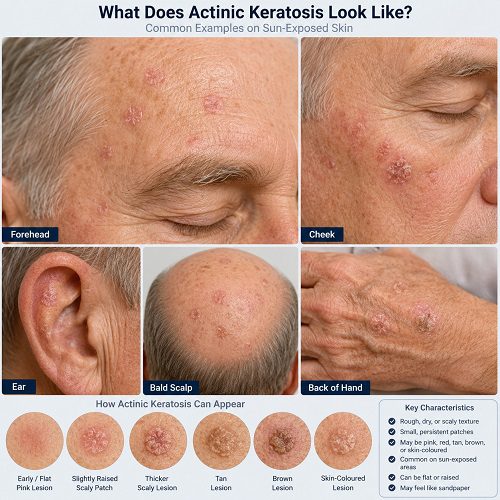
So, what does actinic keratosis look like? In many cases, it appears as a small rough, dry or scaly patch on the skin. The lesion may be easier to feel than to see, particularly during its early stages. Some people describe the texture as similar to sandpaper.
Actinic keratosis can vary considerably in colour, size and thickness. It may appear pink, red, brown, tan, grey or even similar to the surrounding skin colour. Understanding the typical actinic keratosis appearance can help people recognise suspicious changes and seek appropriate medical advice.
What Is Actinic Keratosis?
What Is Actinic Keratosis? Actinic keratosis, sometimes called solar keratosis, is an area of damaged skin caused by cumulative UV exposure. Years of sunlight can damage skin cells and cause abnormal changes in the outer layer of the skin.
The condition is particularly common in people who spend a significant amount of time outdoors. Farmers, construction workers, athletes and others with regular sun exposure may have a higher risk. However, anyone can develop actinic keratosis, especially after years of exposure to UV radiation.
Actinic keratosis is considered a precancerous skin condition because a small percentage of lesions may eventually progress to squamous cell carcinoma. This does not mean that every lesion will become cancerous, but regular monitoring and appropriate Actinic Keratosis treatment are important.
What Does Actinic Keratosis Look Like in Its Early Stages?
Early actinic keratosis can be difficult to recognise. In some cases, the lesion is almost invisible.
One of the earliest signs for Actinic Keratosis is often a rough area of skin that feels different from the surrounding skin. You may notice a tiny dry patch when washing your face or touching your scalp.
Early lesions may have the following characteristics:
- Rough or gritty texture
- Dry and slightly scaly skin
- Small flat patches
- Mild redness or discolouration
- A sandpaper-like feeling
- Slight thickening of the skin
- Persistent dry spots that do not improve
In the beginning, the lesion may be easier to feel than to see. This is one reason why regular skin examinations are important, particularly for people with significant lifetime sun exposure.
Some lesions remain small and subtle, while others gradually become thicker and more visible.
The Typical Actinic Keratosis Appearance
The actinic keratosis appearance can vary from person to person. A lesion may look quite different depending on the individual’s skin tone, the location of the lesion and how long it has been present.
Typical characteristics include:
Rough and Scaly Texture
A rough texture is one of the most common features. The surface may feel dry, crusty or flaky.
Many people notice that moisturisers temporarily soften the area but do not make the patch disappear completely.
Flat or Slightly Raised Patch
Actinic keratosis may begin as a flat area but can become slightly raised over time. Some lesions develop a thicker, crust-like surface.
Irregular Borders
The edges of the lesion may not always be clearly defined. The affected area may gradually blend into surrounding sun-damaged skin.
Persistent Skin Changes
Unlike temporary dry skin, actinic keratosis often persists. The patch may remain for weeks or months and can occasionally disappear and return.
Multiple Lesions
People with extensive sun damage may develop several lesions at the same time. These skin lesions often occur in clusters on frequently exposed areas.
What Colours Can Actinic Keratosis Be?
There is no single colour associated with actinic keratosis. The appearance can vary widely.
Common colours include:
- Pink
- Red
- Light brown
- Dark brown
- Tan
- Grey
- Yellowish
- Skin-coloured
On lighter skin tones, actinic keratosis may appear as a pink or red scaly patch. On darker skin tones, it may appear darker than the surrounding skin or present mainly as a rough, textured area.
The colour may also change over time. A lesion can become redder or darker because of inflammation, irritation or additional sun damage.
Because appearance alone cannot always determine whether a lesion is harmless, precancerous or cancerous, persistent skin changes should be assessed by a qualified healthcare professional.
Where Does Actinic Keratosis Usually Appear?
Actinic keratosis usually develops on areas that receive regular sunlight.
Common locations include:
Face
The face is one of the most common areas. Lesions may appear on the forehead, cheeks, nose and temples.
A rough patch that repeatedly develops on the face should not be ignored, particularly in people with long-term sun exposure.
Ears
The tops and outer edges of the ears receive significant UV exposure. Actinic keratosis on the ears may appear as small rough or crusty patches.
Scalp
People with thinning hair or bald areas are particularly vulnerable to sun damage on the scalp. Multiple rough, scaly spots may develop over time.
Lips
Actinic keratosis can affect the lips, particularly the lower lip. This condition is sometimes referred to as actinic cheilitis.
The lips may become persistently dry, rough or scaly.
Neck
The neck is frequently exposed to sunlight and may develop small rough patches, particularly on the sides and back.
Back of the Hands
The backs of the hands receive years of cumulative sun exposure. Actinic keratosis may appear as rough, scaly or crusted spots.
Forearms
The forearms are another common location, especially among people who work or spend significant time outdoors.
What Do Actinic Keratosis Pictures Usually Show?
Searching for actinic keratosis pictures can help people understand the general appearance of the condition. However, photographs should not be used as a replacement for a professional diagnosis.
Images commonly show:
- Small red or pink scaly patches
- Rough, crusted areas
- Brown or tan spots with a gritty surface
- Thickened skin patches
- Multiple lesions on sun-exposed areas
- Flat or slightly raised spots
- Areas of surrounding sun damage
It is important to remember that skin conditions can look very different depending on skin tone and individual characteristics.
Some actinic keratoses look obvious, while others are extremely subtle. A lesion may also resemble eczema, psoriasis, seborrhoeic keratosis, warts or certain types of skin cancer.
For this reason, comparing a suspicious spot with online photographs is not enough to confirm a diagnosis.
Can Actinic Keratosis Feel Different From Normal Skin?
Yes. In fact, texture changes are often among the first noticeable Actinic Keratosis symptoms.
Many people describe actinic keratosis as feeling:
- Rough
- Gritty
- Dry
- Crusty
- Scaly
- Thickened
- Sandpaper-like
You may notice the patch while shaving, washing your face or applying skincare products.
Sometimes a person repeatedly feels the same rough spot even though they cannot clearly see it.
A persistent rough patch should be monitored, especially if it occurs on a sun-exposed part of the body.
Can Actinic Keratosis Itch or Hurt?
Some actinic keratoses cause no discomfort at all. Others may produce mild symptoms.
Possible sensations include:
- Itching
- Burning
- Tenderness
- Stinging
- Sensitivity
- Mild pain
A lesion may become irritated after sun exposure or friction.
Pain, bleeding or rapid changes in appearance may require prompt medical assessment because these changes can occasionally indicate progression to a more serious condition.
How Big Is an Actinic Keratosis?
Most lesions are relatively small. They often measure only a few millimetres in diameter.
However, size can vary.
Some lesions remain tiny, while others grow larger or merge with nearby areas of sun-damaged skin. People with extensive UV damage may develop an area known as field cancerisation, where large sections of skin contain multiple abnormal cells.
This is particularly common on the face and scalp.
How Does Actinic Keratosis Change Over Time?
Actinic keratosis does not always follow the same pattern. Some lesions remain stable for years, while others become thicker or more noticeable.
Possible changes include:
- Increasing roughness
- Thickening of the lesion
- More visible scaling
- Changes in colour
- Development of a crust
- Enlargement
- Tenderness
Some lesions may temporarily disappear and later return.
Although spontaneous improvement can occur, visible improvement does not necessarily mean that all abnormal skin cells have disappeared. This is why regular follow-up is important for people with recurring or multiple lesions.
What Is the Difference Between Actinic Keratosis and Ordinary Dry Skin?
Dry skin usually improves with moisturising and avoiding irritating products.
Actinic keratosis tends to behave differently.
A suspicious lesion may:
- Remain in the same location
- Feel rough despite moisturising
- Persist for several weeks or months
- Repeatedly return
- Become thicker over time
- Develop visible scaling
Ordinary dry skin often affects broader areas, while actinic keratosis usually appears as a distinct patch or spot.
However, these differences are not always clear. A dermatologist may use a physical examination and specialised equipment to assess suspicious skin lesions.
Can Actinic Keratosis Look Like a Wart?
Yes. Some thicker lesions can resemble warts because they may become raised and rough.
However, actinic keratosis and warts have different causes.
Warts are generally caused by certain strains of human papillomavirus, while actinic keratosis develops mainly because of cumulative UV damage.
A healthcare professional can usually distinguish between these conditions through examination. In uncertain cases, a skin biopsy may be recommended.
Can Actinic Keratosis Look Like Skin Cancer?
Yes. Some types of skin cancer can resemble actinic keratosis.
Squamous cell carcinoma, in particular, may develop from areas of sun-damaged skin and can appear as a persistent scaly or crusted lesion.
Warning signs that require medical attention include:
- Rapid growth
- Bleeding
- Persistent soreness
- Significant thickening
- Development of a hard lump
- An open sore that does not heal
- Major changes in colour or shape
Not every changing lesion is cancerous, but it is important to have suspicious changes examined promptly.
How Do Dermatologists Identify Actinic Keratosis?
Dermatologists often diagnose actinic keratosis through a clinical examination.
They may assess:
- Texture
- Colour
- Size
- Location
- Number of lesions
- Surrounding sun damage
A dermatoscope may also be used. This handheld device allows the doctor to examine structures beneath the surface of the skin.
If the diagnosis is uncertain or there are signs suggesting skin cancer, a biopsy may be performed. During a biopsy, a small sample of the affected skin is examined under a microscope.
This can help distinguish actinic keratosis from other skin conditions.
Who Is Most Likely to Develop Actinic Keratosis?
Several factors can increase the likelihood of developing actinic keratosis.
These include:
Long-Term Sun Exposure
Years of UV exposure are the primary cause.
Fair or Easily Sunburned Skin
People with lighter skin tones may have a higher risk, although actinic keratosis can occur in people of all skin types.
Older Age
The risk increases with age because UV damage accumulates over time.
Outdoor Occupations
People who regularly work outside may experience greater lifetime UV exposure.
Previous Sunburns
Repeated severe sunburns can increase long-term skin damage.
Weakened Immune System
People with weakened immune systems may have a higher risk of developing multiple or more aggressive lesions.
When Should You See a Doctor?
You should consider seeing a doctor or dermatologist if you notice a persistent or changing skin lesion.
Seek medical advice if a spot:
- Does not heal
- Continues growing
- Bleeds easily
- Becomes painful
- Develops a thick crust
- Changes significantly in colour
- Appears repeatedly in the same location
Early assessment can help identify actinic keratosis and rule out more serious conditions.
Regular skin checks are particularly important for people with a history of extensive sun exposure or previous skin cancer.
Can You Prevent New Actinic Keratoses?
Although previous sun damage cannot always be reversed completely, protecting the skin from additional UV exposure can help reduce the risk of developing new lesions.
Important prevention strategies include:
Use Sunscreen
Apply a broad-spectrum sunscreen with an appropriate SPF and reapply according to product instructions, particularly during extended outdoor activities.
Wear Protective Clothing
Long sleeves, wide-brimmed hats and UV-protective clothing can reduce direct sun exposure.
Avoid Peak Sunlight
Try to limit prolonged exposure during the strongest daylight hours.
Avoid Tanning Beds
Artificial UV radiation can also damage skin and increase the risk of skin cancer.
Check Your Skin Regularly
Become familiar with the appearance of your skin and pay attention to persistent rough patches or new growths.
Final Thoughts: What Does Actinic Keratosis Look Like?
So, what does actinic keratosis look like? It most commonly appears as a persistent rough, dry or scaly patch on sun-exposed skin. The lesion may be pink, red, tan, brown, grey or close to the surrounding skin colour. In many cases, it feels like sandpaper and may be easier to detect by touch than sight.
The typical actinic keratosis appearance can vary significantly, which means photographs alone cannot provide a reliable diagnosis. While actinic keratosis pictures can help illustrate common characteristics, any persistent or changing skin lesions should be assessed by a qualified healthcare professional.
Recognising suspicious spots early and protecting the skin from further UV exposure are important steps in maintaining long-term skin health. If you notice a rough patch that does not heal or a lesion that changes over time, seeking professional advice can provide reassurance and ensure appropriate treatment when necessary.