
 By
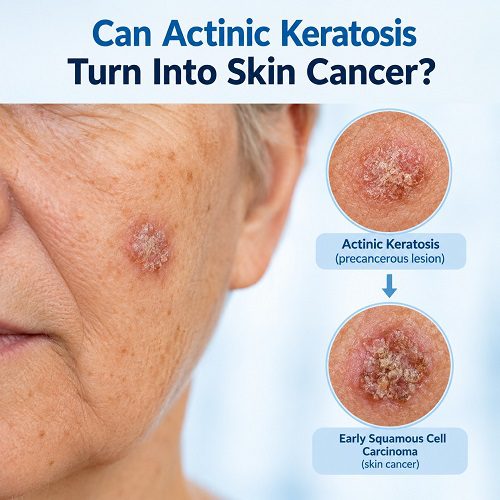
By If you have been diagnosed with actinic keratosis, you may wonder, can actinic keratosis turn into skin cancer? The short answer is yes. Actinic keratosis is not skin cancer, but it is considered a precancerous skin lesion because some lesions can develop into squamous cell carcinoma (SCC), a common type of skin cancer.
Actinic keratoses usually develop after years of ultraviolet (UV) exposure. They often appear as rough, scaly patches on areas of skin that receive frequent sunlight, such as the face, ears, scalp, neck, forearms, backs of the hands and lower lip. The lesions can be red, pink, brown, grey or close to the colour of your skin.
The good news is that most actinic keratoses do not become cancerous. However, an actinic keratosis can indicate significant sun damage and an increased risk of developing skin cancer. For this reason, recognising changes and discussing suspicious lesions with a dermatologist is important.
What Is Actinic Keratosis?
What Is Actinic Keratosis? Actinic keratosis, sometimes called solar keratosis, is a rough or scaly skin growth caused primarily by long-term exposure to ultraviolet radiation. The UV radiation damages skin cells over time, causing abnormal changes in the outer layer of the skin.
According to the National Cancer Institute, actinic keratosis is not cancer, but it can sometimes develop into squamous cell carcinoma.
An actinic keratosis may initially look like a small area of dry skin. Some lesions are easier to feel than see because they have a rough, sandpaper-like texture. They may remain small or become thicker over time.
Common locations include:
- Face and forehead
- Actinic Keratosis on the Ears
- Scalp, particularly in people with thinning or no hair
- Actinic Keratosis on the Neck
- Actinic Keratosis on the Hands
- Forearms
- Actinic Keratosis on the Lips
- Other areas repeatedly exposed to sunlight
Actinic keratosis is generally associated with cumulative sun damage rather than a single episode of sun exposure. Indoor tanning can also contribute to the UV damage that Actinic Keratosis causes these lesions.
Can Actinic Keratosis Turn Into Skin Cancer?
Yes, can actinic keratosis turn into skin cancer? It can, but the important point is that not every actinic keratosis becomes cancer.
The type of skin cancer most closely associated with actinic keratosis is squamous cell carcinoma. The American Academy of Dermatology describes actinic keratoses as precancerous growths because some can progress to SCC.
The National Cancer Institute also describes actinic keratoses as potential precursors of SCC. It notes that the progression rate for an individual lesion is very low and that most actinic keratoses do not become squamous cell carcinoma.
This means you should not automatically assume that an actinic keratosis is cancer. At the same time, it should not simply be ignored.
An actinic keratosis is a warning sign that the skin has experienced significant UV damage. A person who develops actinic keratoses may also have an increased overall Skin Cancer risk, particularly when there are numerous lesions or substantial cumulative sun exposure.
Understanding Actinic Keratosis Cancer Risk
The Actinic Keratosis cancer risk varies from person to person and from lesion to lesion. Doctors cannot always predict which individual lesion will eventually progress to cancer.
Several factors can increase concern, including having numerous actinic keratoses, significant cumulative sun exposure, a history of skin cancer and a weakened immune system.
People who have received an organ transplant, for example, may develop many actinic keratoses because immunosuppressive medicines reduce the body’s ability to respond to UV-related skin damage.
Other factors associated with skin cancer risk include:
- Long-term UV exposure
- Frequent sunburn
- Indoor tanning
- Previous skin cancer
- Older age
- A weakened immune system
- Certain inherited conditions that increase sensitivity to UV radiation
Importantly, people of all skin tones can develop squamous cell carcinoma. While some populations have a higher incidence, darker skin does not eliminate the possibility of UV-related skin cancer.
How Does Actinic Keratosis Progress?
The term actinic keratosis progression describes changes that may occur in a lesion over time.
Actinic keratosis develops when repeated UV exposure causes abnormal changes in skin cells. In some cases, the abnormal cells remain limited to the superficial layer of the skin. In other cases, further cellular changes can eventually result in squamous cell carcinoma.
However, this progression is not inevitable.
Some actinic keratoses may remain stable, while others may disappear without treatment. The NCI reports that spontaneous regression can occur, although this does not mean that sun-damaged skin has returned to normal or that future lesions cannot develop.
Because doctors cannot reliably determine which individual lesions will progress, suspicious or persistent lesions are often evaluated and treated.
What Does Actinic Keratosis Look Like?
Actinic keratosis can appear differently from one person to another. A lesion may be:
- Rough or scaly
- Flat or slightly raised
- Red or pink
- Brown or tan
- Grey
- Skin-coloured
- Tender or sensitive
- Itchy or burning
Some lesions are very small, while others become larger or thicker.
The American Academy of Dermatology notes that actinic keratoses can sometimes bleed, sting, burn or become painful. A horn-like growth can also occur and should be examined promptly because it may be associated with a higher risk of squamous cell carcinoma.
Because actinic keratosis can resemble other skin conditions, including some forms of skin cancer, a dermatologist should assess lesions that are new, changing or unusual.
Signs That an Actinic Keratosis May Need Urgent Evaluation
Although an actinic keratosis does not automatically mean cancer, certain changes deserve medical attention.
Contact a dermatologist if a lesion:
- Becomes noticeably thicker
- Grows rapidly
- Starts bleeding repeatedly
- Develops a persistent crust
- Becomes painful or very tender
- Forms an open sore
- Changes significantly in appearance
- Does not heal
- Develops a firm or raised centre
- Becomes increasingly difficult to distinguish from surrounding skin
These Signs of Actinic Keratosis do not prove that a lesion has become cancerous. However, they can indicate that the diagnosis needs to be reassessed.
Squamous cell carcinoma can appear as a firm red bump or a scaly, crusted or bleeding lesion, particularly on areas exposed to the sun.
Does Every Actinic Keratosis Become Skin Cancer?
No.
This is one of the most important points to understand about actinic keratosis.
Most actinic keratoses do not progress to invasive squamous cell carcinoma. The NCI describes the progression rate of an individual actinic keratosis as extremely low.
However, having actinic keratoses means your skin has already experienced considerable sun damage. Therefore, the presence of one or more lesions can be considered an important marker of increased skin cancer risk.
The goal is not to become frightened by every rough patch. Instead, the goal is to recognise actinic keratosis early, protect your skin from further UV damage and obtain appropriate medical evaluation.
How Is Actinic Keratosis Diagnosed?
A dermatologist can often recognise actinic keratosis by examining the skin and considering its appearance, texture and location.
If a lesion looks unusual or there is concern that it may be squamous cell carcinoma, the doctor may recommend a skin biopsy. During a biopsy, part or all of the suspicious tissue is removed and examined under a microscope.
A biopsy can help distinguish actinic keratosis from skin cancer and other skin conditions. The NCI lists skin examination and biopsy among the procedures used to evaluate suspicious skin changes.
You should not attempt to diagnose or remove a suspicious lesion yourself.
How Is Actinic Keratosis Treated?
Actinic Keratosis Treatment depends on factors such as the number of lesions, their location, thickness, appearance, previous treatment and the person’s overall health.
Common medical treatments include:
- Cryotherapy
- Prescription topical treatments
- Curettage and electrodesiccation
- Shave or surgical removal
- Photodynamic therapy
- Other dermatologist-directed treatments
Cryotherapy uses extreme cold to destroy the abnormal cells. Topical treatments may be recommended when multiple lesions or a larger area of sun-damaged skin needs treatment.
The NCI lists several established treatment approaches for actinic keratosis, including topical medicines, cryosurgery, excision, curettage and electrodesiccation, photodynamic therapy and other procedures.
Treatment can remove individual lesions and may help prevent progression. However, treating one lesion does not remove the underlying history of sun damage, so new actinic keratoses can develop later.
Can Treating Actinic Keratosis Reduce Skin Cancer Risk?
Treating actinic keratosis can help address precancerous lesions before they potentially progress.
The American Academy of Dermatology states that treating a precancerous growth can prevent that particular growth from progressing to skin cancer.
Research has also investigated whether treating sun-damaged areas can reduce future squamous cell carcinoma. The NCI reports that topical fluorouracil treatment of sun-damaged skin reduced the risk of SCC requiring surgery for one year in a specific high-risk study population.
However, treatment decisions should be personalised. Not everyone with actinic keratosis needs the same treatment, and prescription medicines such as fluorouracil or imiquimod should only be used according to a healthcare professional’s instructions.
How Can You Reduce Your Skin Cancer Risk?
Preventing additional UV damage is an important part of managing actinic keratosis.
Consider these practical steps:
1. Use Sun Protection
Use a broad-spectrum sunscreen with an appropriate SPF and apply it as directed. Reapply when necessary, especially after swimming, sweating or prolonged outdoor activity.
2. Wear Protective Clothing
Long sleeves, trousers, wide-brimmed hats and UV-protective clothing can reduce direct sun exposure.
3. Seek Shade
When possible, stay in shaded areas during periods of strong sunlight.
4. Avoid Indoor Tanning
Tanning beds and sunlamps expose the skin to UV radiation and can contribute to skin damage.
5. Check Your Skin Regularly
Become familiar with your normal skin appearance. Look for new growths or changes in existing lesions.
6. Attend Dermatology Appointments
If you have been diagnosed with actinic keratosis, follow your dermatologist’s recommendations for treatment and monitoring.
The American Academy of Dermatology emphasises that UV damage accumulates over time and recommends protecting skin from further UV exposure.
Actinic Keratosis vs Squamous Cell Carcinoma
Although they can look similar, actinic keratosis and squamous cell carcinoma are not the same condition.
Actinic keratosis is a precancerous lesion associated with UV damage. It may appear as a rough, scaly patch and usually remains confined to the superficial skin.
Squamous cell carcinoma is a form of skin cancer that develops from abnormal keratinocytes. It may appear as a firm growth, scaly patch, crusted lesion, bleeding sore or other persistent change.
Because appearance alone may not always distinguish the two, a dermatologist should assess suspicious lesions.
When Should You See a Dermatologist?
You should consider professional evaluation if you notice a persistent rough or scaly patch, especially on an area that receives regular sun exposure.
Seek prompt medical assessment if the lesion becomes thicker, painful, repeatedly bleeds, develops a persistent crust, grows rapidly or becomes an open sore.
You should also discuss regular skin examinations with a healthcare professional if you have multiple actinic keratoses, a previous history of skin cancer or a weakened immune system.
Early evaluation is valuable because skin cancer is generally easier to manage when detected at an earlier stage.
Final Thoughts: Can Actinic Keratosis Turn Into Skin Cancer?
So, can actinic keratosis turn into skin cancer? Yes. Some actinic keratoses can progress to squamous cell carcinoma, but most individual lesions do not become cancer.
The presence of actinic keratosis is nevertheless an important sign of cumulative UV damage. It can indicate an increased Skin Cancer risk, particularly when multiple lesions are present or other risk factors exist.
Understanding actinic keratosis progression can help you recognise why monitoring and appropriate treatment matter. Do not panic if you have an actinic keratosis, but do not ignore it either.
Protect your skin from further UV exposure, monitor for changes and seek professional medical advice about persistent or suspicious lesions. Early evaluation and appropriate treatment can help manage actinic keratoses and identify skin cancer when it occurs.
Medical Disclaimer
This article is provided for general educational and informational purposes only. It is not intended to diagnose, treat, cure or prevent actinic keratosis, squamous cell carcinoma or any other medical condition. If you have a new, changing, painful, bleeding or persistent skin lesion, consult a qualified dermatologist or other healthcare professional for an appropriate examination and diagnosis.