 By
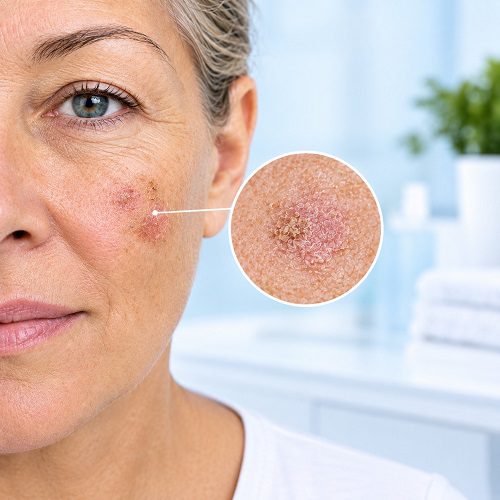
By Actinic keratosis (AK) is a common sun-related skin condition that develops after long-term exposure to ultraviolet (UV) radiation. It usually appears as a rough, scaly, or sandpaper-like patch on areas such as the face, scalp, Actinic Keratosis on the Ears, forearms, and backs of the Actinic Keratosis on the Hands. Although an individual actinic keratosis may remain stable or sometimes disappear, AKs are considered precancerous lesions because some can progress to cutaneous squamous cell carcinoma.
One prescription option used for suitable patients is imiquimod for actinic keratosis. Unlike treatments that simply destroy abnormal cells directly, imiquimod is an immune response modifier. It stimulates local immune activity in the skin, helping the body’s immune system recognise and eliminate abnormal cells.
How imiquimod works, what patients may experience during treatment, how imiquimod cream differs from other topical approaches, and why medical supervision is important.
What Is Actinic Keratosis?
What Is Actinic Keratosis? Actinic keratosis is a change in the outer layer of the skin caused primarily by cumulative UV exposure. The condition can appear as a rough or flaky patch that may be skin-coloured, pink, red, yellowish, or darker than the surrounding skin.
Some AKs are easier to feel than see. A person may notice a rough patch when running a finger over the skin even when the lesion is difficult to identify visually.
AKs most commonly occur on chronically sun-exposed areas. People with substantial lifetime sun exposure, frequent sunburns, or certain risk factors may develop multiple lesions. Having multiple AKs can indicate significant cumulative sun damage.
Because AKs can sometimes progress to skin cancer, dermatologists commonly recommend treatment when appropriate rather than simply ignoring persistent lesions.
What Is Imiquimod?
Imiquimod is a topical immune response modifier. It is available in prescription creams in different strengths and formulations, depending on the indication and country.
For actinic keratosis, imiquimod is applied directly to the affected skin according to a treatment schedule prescribed by a healthcare professional.
The important point is that imiquimod is not simply a moisturiser or conventional cosmetic Actinic Keratosis treatment cream. It is a medicine designed to produce a local immune response.
The FDA prescribing information describes imiquimod cream as a topical treatment for clinically typical, nonhyperkeratotic and nonhypertrophic actinic keratoses of the face or Actinic Keratosis on the Scalp in immunocompetent adults. Specific formulations and indications can differ, so patients should follow the product information and their prescriber’s instructions.
How Does Imiquimod for Actinic Keratosis Work?
The mechanism of imiquimod is based on immune stimulation.
Imiquimod interacts with toll-like receptor 7 (TLR7), a receptor involved in the body’s innate immune response. Activation of this pathway can stimulate immune cells and promote the release of cytokines and other signalling molecules.
These immune signals contribute to an inflammatory response in the treated skin. The resulting immune activity can help the body identify and remove abnormal cells associated with actinic keratosis.
The exact mechanism by which imiquimod produces its clinical effect in AK is not completely established. The FDA prescribing information specifically notes that the mechanism of action for treating AK is unknown, even though its immune-modulating activity is well characterised.
In simple terms, imiquimod for actinic keratosis helps activate the local immune response rather than functioning only as a conventional chemical exfoliant or cell-destroying treatment.
Why Does Imiquimod Cause Skin Inflammation?
One of the most important things to understand about imiquimod is that inflammation can be part of the expected treatment response.
During treatment, the skin may become:
- Red
- Dry
- Scaly
- Flaky
- Swollen
- Crusted
- Tender
- Irritated
The intensity of the reaction varies from person to person.
DermNet explains that imiquimod stimulates cytokine production and produces inflammation that contributes to destruction of abnormal or diseased skin cells.
This means that seeing redness or scaling does not automatically indicate that the treatment is harming healthy skin. However, severe reactions should not simply be ignored. Patients should contact their healthcare professional if the reaction becomes unusually painful, interferes significantly with daily activities, or Actinic Keratosis causes concerning symptoms.
How Is Imiquimod Cream Used for Actinic Keratosis?
The exact schedule depends on the strength and formulation prescribed.
For example, dermatology guidance describes imiquimod as one of the topical medicines that can be used for AK, with some treatment schedules involving application once or twice weekly over a number of weeks. Other approved formulations use different schedules.
This is why patients should not copy a treatment schedule from another person or online article.
A dermatologist may consider:
- The location of the AK
- The number of lesions
- The thickness of the lesions
- The formulation and strength of imiquimod
- Previous treatments
- Skin sensitivity
- Other medical conditions
- The patient’s ability to follow the treatment plan
The treatment area should generally be prepared and the medicine applied exactly as directed by the prescribing clinician and product information.
What Happens During Treatment?
The appearance of the treated skin can change during an imiquimod course.
A typical progression may include increasing redness followed by scaling, dryness, crusting, or irritation. The reaction can become more noticeable before the skin gradually recovers.
The FDA information for one imiquimod formulation notes that erythema, flaking/scaling, dryness, and scabbing/crusting can occur during treatment for AK.
The visible reaction is one reason people sometimes stop treatment prematurely.
However, stopping or changing the treatment schedule without medical advice may affect the intended treatment course. If the reaction becomes difficult to tolerate, a healthcare professional can determine whether treatment needs to be paused, modified, or reassessed.
Is Inflammation Always Necessary?
Inflammation is an important part of imiquimod’s action, but more inflammation does not necessarily mean better treatment.
Patients should not deliberately apply excessive quantities or use imiquimod more frequently than prescribed in an attempt to produce a stronger reaction.
Using too much medicine can increase irritation and may damage the skin barrier.
The appropriate response varies between individuals, so the goal should be to follow the prescribed treatment schedule rather than trying to achieve a particular visual reaction.
Imiquimod Cream as a Field Treatment
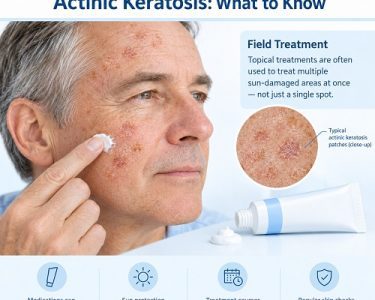
One advantage of topical therapy is that it can be used over a defined area rather than only targeting one visible lesion.
This approach is particularly relevant when there are multiple AKs or areas of sun-damaged skin containing lesions that may not be obvious to the naked eye.
The American Academy of Dermatology notes that at-home topical treatments can address multiple AKs, including some lesions that a patient cannot easily see.
This is different from lesion-directed treatments such as cryotherapy, which are commonly used to freeze individual lesions.
A dermatologist may therefore choose between field-directed and lesion-directed treatment based on the patient’s particular presentation.
How Does Imiquimod Compare With Other Topical Therapy?
Imiquimod is only one option among several Treatments for Actinic Keratosis.
Other topical therapies include 5-fluorouracil, diclofenac and tirbanibulin, while photodynamic therapy and procedures such as cryosurgery may also be considered.
The American Academy of Dermatology gives a strong recommendation for topical imiquimod and 5-fluorouracil among AK treatment options.
The appropriate choice depends on factors such as:
- Number of AKs
- Location
- Thickness
- Size of the treatment area
- Previous treatments
- Patient preferences
- Tolerability
- Medical history
Therefore, one topical therapy should not automatically be considered suitable for everyone.
Who May Be Prescribed Imiquimod?
Imiquimod may be considered for adults with appropriate actinic keratoses, particularly when field treatment is appropriate.
However, not every rough or scaly skin lesion is an AK.
A lesion that is thick, rapidly growing, painful, bleeding, ulcerated, or otherwise suspicious may require further examination. A dermatologist may decide that a biopsy or another treatment is necessary rather than simply prescribing topical imiquimod.
The FDA indication for a 5% imiquimod formulation specifically refers to clinically typical, nonhyperkeratotic, nonhypertrophic Actinic Keratosis of the face or scalp in immunocompetent adults.
This highlights why self-diagnosis is not recommended.
Possible Side Effects of Imiquimod
Local reactions are among the most common issues associated with imiquimod.
Possible reactions include:
- Redness
- Burning
- Itching
- Irritation
- Dryness
- Scaling
- Crusting
- Swelling
- Tenderness
More significant inflammatory reactions can occur in some patients.
Some people may also experience systemic symptoms such as fatigue, fever, headache, muscle aches, or other flu-like symptoms. These should be discussed with a healthcare professional, particularly when they are significant or persistent.
Changes in skin pigmentation can also occur after treatment in some individuals.
What Should You Avoid During Treatment?
Sun protection remains important because AKs are caused by cumulative UV damage.
Patients using imiquimod should follow their clinician’s advice regarding sun exposure and sunscreen. The FDA prescribing information recommends minimising or avoiding natural and artificial sunlight exposure during treatment and encouraging sunscreen use.
Useful protective measures may include:
- Wearing protective clothing
- Using a broad-spectrum sunscreen as directed
- Seeking shade
- Avoiding tanning beds
- Limiting unnecessary prolonged sun exposure
- Continuing long-term sun protection after treatment
Treating an existing AK does not reverse all previous UV damage, so prevention remains important.
Why Medical Diagnosis Matters Before Using Imiquimod
A common mistake is assuming every rough patch is an actinic keratosis.
Several skin conditions can resemble AK. Some skin cancers may also initially look like scaly or irritated patches.
A dermatologist can examine the lesion and determine whether it is appropriate for topical treatment.
The American Academy of Dermatology recommends professional evaluation because people with AKs have increased risk of developing skin cancer, and examinations can help identify suspicious lesions.
If a lesion becomes thicker, tender, enlarged, ulcerated, or persistently fails to respond to treatment, it deserves medical reassessment.
Can Imiquimod Prevent New Actinic Keratoses?
Imiquimod can treat the selected area of abnormal skin, but it should not be viewed as a permanent cure for sun damage.
A person who has developed AK has evidence of cumulative UV exposure and may continue developing new lesions.
This makes ongoing skin monitoring and sun protection important even after successful treatment.
The AAD notes that people with multiple AKs may continue developing new lesions and can have increased skin-cancer risk because of their underlying sun damage.
What Should Patients Ask Their Dermatologist?
Before beginning imiquimod for actinic keratosis, useful questions include:
- Is the lesion definitely an actinic keratosis?
- Which imiquimod formulation and strength am I using?
- How often should I apply the cream?
- How long should each treatment course last?
- Which areas should I treat?
- What level of redness or irritation is expected?
- When should I stop and contact you?
- Should I use sunscreen during treatment?
- Are there medicines or skin products I should avoid?
- When should the treated area be checked again?
These questions can help ensure that treatment is used safely and appropriately.
Imiquimod for Actinic Keratosis: Key Takeaways
Imiquimod for actinic keratosis is a prescription topical treatment that works by modifying the local immune response. It interacts with immune pathways, including TLR7 signalling, and promotes an inflammatory response that can help eliminate abnormal cells.
Unlike a simple cosmetic cream, imiquimod cream is a medicinal treatment that should be used according to professional instructions.
Redness, scaling, dryness, crusting, and irritation can occur during treatment. These reactions can be expected, but severe or unusual symptoms should be discussed with a healthcare professional.
Because actinic keratosis can sometimes progress to squamous cell carcinoma, Actinic Keratosis Diagnosis and appropriate treatment matter. Dermatologists can determine whether imiquimod, another topical therapy, cryotherapy, photodynamic therapy, or another approach is appropriate.
Finally, treating AK does not eliminate the need for sun protection. Protecting the skin from further UV exposure is an important part of long-term skin health.
Medical Disclaimer
This article is for educational purposes only and does not replace diagnosis, treatment, or advice from a qualified healthcare professional. Imiquimod is a prescription medicine and should be used only as directed by a healthcare professional and according to the relevant product information. Do not start, stop, or change an imiquimod treatment schedule without professional advice. Any persistent, rapidly changing, thickened, painful, bleeding, ulcerated, or otherwise unusual skin lesion should be evaluated by a dermatologist.