
 By
By The neck is one of the areas of skin that can receive considerable sun exposure, yet it is often overlooked when people apply sunscreen or check their skin for unusual changes. Over many years, ultraviolet (UV) radiation can damage skin cells and cause rough, scaly patches known as actinic keratoses.
Actinic Keratosis on the Neck is particularly important to recognise because an actinic keratosis can sometimes develop into squamous cell carcinoma, a type of skin cancer. Most actinic keratoses do not become cancerous, but identifying and treating suspicious lesions can help reduce potential risks.
These lesions may be small and easy to overlook, especially during their early stages. Understanding the appearance, causes and risk factors can help you recognise changes and know when to seek medical advice.
What Is Actinic Keratosis?
What Is Actinic Keratosis? Actinic keratosis is a common precancerous skin condition caused primarily by long-term exposure to ultraviolet radiation. It develops when UV light damages the DNA of skin cells, particularly keratinocytes, which are the predominant cells in the outer layer of the skin.
Actinic keratoses usually develop on areas that receive frequent sun exposure. Common locations include the:
- Actinic Keratosis on the Face
- Forehead
- Actinic Keratosis on the Scalp, particularly in people with hair loss
- Actinic Keratosis on the Ears
- Actinic Keratosis on the Lips
- Forearms
- Actinic Keratosis on the Hands
- Neck
A lesion may initially look like a small area of rough or dry skin. Sometimes you can feel an actinic keratosis more easily than you can see it because it may have a sandpaper-like texture.
The colour can vary. Lesions may appear pink, red, tan, brown, white or close to the person’s natural skin tone.
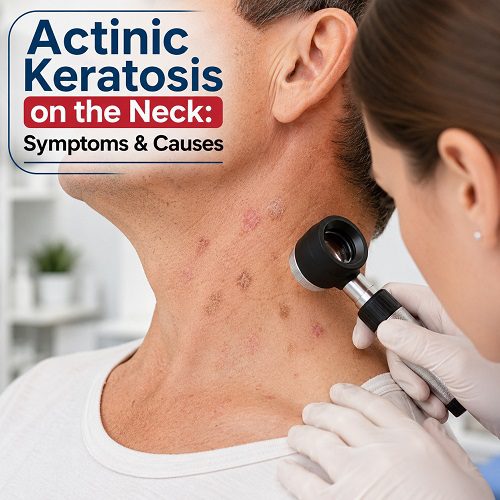
What Does Actinic Keratosis on the Neck Look Like?
Actinic Keratosis on the Neck can appear differently from one person to another. A lesion may be only a few millimetres across, although some patches can become larger.
Typical features include:
- Rough or gritty texture
- Dry, flaky or scaly surface
- Flat or slightly raised appearance
- Pink or reddish colour
- Tan or brown discolouration
- Skin-coloured patches
- Mild thickening
- Persistent crusting
- Tenderness or sensitivity
Some lesions are more noticeable because they have a distinct colour compared with surrounding skin. Others may blend into the surrounding skin and primarily be identified by their rough texture.
The neck can also develop multiple lesions rather than a single patch. When several rough areas occur across sun-exposed skin, this can indicate significant cumulative UV exposure.
Actinic Keratosis Symptoms
Recognising actinic keratosis symptoms can help you distinguish potentially concerning changes from ordinary dry skin.
Early symptoms may include a rough patch that feels different from the surrounding skin. You might notice a small area of dryness that does not improve despite regular moisturising.
Other possible symptoms include:
Rough or Scaly Skin
A rough, scaly texture is one of the most characteristic signs. The lesion may feel similar to fine sandpaper when you run a finger over it.
Changes in Colour
Actinic keratoses may be pink, red, brown, tan, white or skin-coloured. The colour may become more noticeable as the lesion develops.
Slight Thickening
Some lesions become thicker over time. They may feel raised compared with the surrounding skin.
Itching or Irritation
An actinic keratosis may itch, burn, sting or feel irritated, although some lesions cause no symptoms at all.
Tenderness
A lesion that becomes painful or unusually sensitive should be assessed by a healthcare professional, particularly if the change is persistent.
Crusting or Bleeding
A lesion that repeatedly crusts or bleeds deserves medical evaluation. These changes do not necessarily mean that cancer has developed, but they can be signs of a more advanced or suspicious lesion.
What Causes Actinic Keratosis on the Neck?
The main cause of Actinic Keratosis on the Neck is cumulative exposure to UV radiation.
Sunlight contains UVA and UVB radiation. Repeated exposure can cause cellular damage that accumulates over many years. Eventually, damaged skin cells may begin to grow abnormally, resulting in actinic keratoses.
Cumulative Sun Exposure
Actinic keratosis is strongly associated with long-term sun exposure. You do not necessarily need to experience frequent sunburns for UV damage to accumulate.
Everyday activities such as walking, gardening, driving and spending time outdoors can contribute to lifetime UV exposure.
Occupational Sun Exposure
People who work outdoors may have a higher risk because they can receive prolonged UV exposure over many years.
Outdoor occupations can include:
- Construction work
- Farming
- Gardening
- Landscaping
- Outdoor maintenance
- Lifeguarding
- Sports-related work
Recreational Sun Exposure
Regular outdoor activities without adequate sun protection can also increase cumulative UV exposure.
Spending holidays in sunny climates, participating in outdoor sports or frequently sunbathing can contribute to long-term skin damage.
Risk Factors for Actinic Keratosis
Although anyone can develop actinic keratosis, some people have a higher risk.
Important risk factors include:
Age
Actinic keratoses become more common with increasing age because UV damage accumulates over time. However, younger people with substantial sun exposure can also develop them.
Fair Skin
People with fair skin, particularly those who burn easily and tan poorly, generally have a greater risk of developing actinic keratoses.
History of Sunburn
Repeated sunburn can cause significant UV-related skin damage and increase the likelihood of developing actinic keratoses later in life.
Outdoor Lifestyle
Spending substantial amounts of time outdoors without adequate protection increases cumulative UV exposure.
Previous Skin Cancer
People who have previously had certain types of skin cancer may be more likely to develop actinic keratoses and other sun-related skin abnormalities.
Weakened Immune System
People with weakened immune systems can have an increased risk of actinic keratoses and may develop more numerous or persistent lesions.
Neck Skin Lesions: When Should You Be Concerned?
Not every unusual patch on the neck is an actinic keratosis. Other conditions can cause neck skin lesions, including eczema, psoriasis, seborrhoeic keratoses, warts and various types of dermatitis.
Because several skin conditions can look similar, it is not always possible to identify an actinic keratosis simply by looking at it.
You should arrange a medical assessment if a lesion:
- Continues to grow
- Becomes increasingly thick
- Bleeds repeatedly
- Develops persistent crusting
- Becomes painful or tender
- Changes significantly in colour
- Develops an irregular appearance
- Does not heal
- Returns after apparently disappearing
A rapidly changing or unusually thick lesion deserves particular attention.
Can Actinic Keratosis Become Skin Cancer?
Actinic keratosis is considered a precancerous skin change. Some lesions can progress to squamous cell carcinoma (SCC), although most do not.
There is no reliable way for an individual to determine which lesion will progress. This is why persistent, changing or suspicious lesions should be evaluated by a dermatologist or another qualified healthcare professional.
Squamous cell carcinoma can often be treated successfully, particularly when detected early. Seeking medical advice about changing lesions is therefore an important part of protecting your long-term skin health.
How Is Actinic Keratosis Diagnosed?
A healthcare professional will usually examine the affected area closely. A dermatologist may use a dermatoscope, which provides magnification and specialised illumination to examine structures within the skin.
In some cases, a biopsy may be recommended. This involves removing a small sample of tissue so that it can be examined under a microscope.
A biopsy may be particularly appropriate when a lesion:
- Looks unusual
- Is thick or heavily keratinised
- Bleeds
- Is painful
- Does not respond to treatment
- Could potentially represent skin cancer
Diagnosis is important because treatment depends on the type and extent of the lesion.
Treatment for Actinic Keratosis on the Neck
Actinic Keratosis Treatment depends on factors such as the number of lesions, their size, thickness, location and appearance.
Common treatment approaches include:
Cryotherapy
Cryotherapy uses extreme cold, usually liquid nitrogen, to destroy the abnormal cells. The treated area may blister or crust before healing.
Prescription Topical Treatments
Certain prescription creams or gels can treat actinic keratoses. Depending on the medication, treatment may destroy abnormal cells or stimulate the body’s immune response against them.
Photodynamic Therapy
Photodynamic therapy uses a light-sensitive medication followed by exposure to a specific wavelength of light. It can be useful when multiple lesions are present in a particular area.
Curettage
A healthcare professional may remove a thicker lesion using a technique called curettage. This is generally performed when the lesion’s characteristics make physical removal appropriate.
Laser Treatment
In selected cases, laser therapy may be considered. The most suitable treatment depends on the individual lesion and the patient’s circumstances.
It is important not to attempt to remove or treat suspicious neck skin lesions at home.
Preventing Further Sun Damage
Preventing additional UV exposure is an important part of managing actinic keratosis.
Use Sunscreen
Apply a broad-spectrum sunscreen with an appropriate SPF to exposed skin. Remember to include the front, sides and back of the neck.
Reapply sunscreen as directed, particularly after sweating, swimming or prolonged outdoor activity.
Wear Protective Clothing
A wide-brimmed hat and clothing that covers the neck can provide additional protection.
Seek Shade
Whenever possible, reduce direct sun exposure, particularly when UV levels are high.
Avoid Tanning Beds
Artificial tanning devices can expose the skin to UV radiation and contribute to long-term skin damage.
Check Your Skin Regularly
Regularly examine your skin for new or changing patches. Pay attention to areas that receive frequent sun exposure, including the neck.
How to Check Your Neck for Actinic Keratosis
Checking your neck can be difficult because some areas are hard to see. Using a mirror or asking someone you trust to help can make examination easier.
Look and feel for:
- New rough patches
- Persistent scaling
- Areas of redness
- Unusual thickening
- Persistent crusting
- New or changing lesions
- Spots that repeatedly bleed
You do not need to diagnose the lesion yourself. The purpose of skin checks is to identify changes that should be assessed professionally.
Actinic Keratosis vs Other Neck Skin Conditions
A rough patch on the neck does not automatically mean actinic keratosis.
For example, eczema can cause dryness, itching and inflammation, while seborrhoeic keratoses may appear as raised, waxy or stuck-on growths. Psoriasis can cause well-defined, scaly plaques.
Because these conditions can overlap in appearance, persistent or unusual changes should be examined by a healthcare professional rather than treated based solely on appearance.
Frequently Asked Questions
Is Actinic Keratosis on the Neck serious?
It can be important because actinic keratosis is a precancerous skin change. Most lesions do not become cancerous, but some can progress to squamous cell carcinoma. Persistent or changing lesions should therefore be assessed.
Can actinic keratosis disappear on its own?
Some actinic keratoses may temporarily become less noticeable or disappear, but others persist or return. A healthcare professional can determine whether treatment or monitoring is appropriate.
Does actinic keratosis hurt?
Many lesions cause no symptoms. However, some may itch, sting, burn or become tender, particularly when they become thicker or irritated.
Can sunscreen prevent actinic keratosis?
Regular use of broad-spectrum sunscreen can reduce UV exposure and help protect against further sun damage. However, no sunscreen provides complete protection, so combining sunscreen with protective clothing and shade is beneficial.
Can younger adults develop actinic keratosis?
Yes. Although it is more common with age, younger adults with substantial cumulative UV exposure can develop actinic keratoses.
Final Thoughts
Actinic Keratosis on the Neck is a common sun-related skin condition that develops as a result of cumulative UV damage. It typically appears as a rough, scaly or slightly thickened patch that may be pink, red, brown, tan or skin-coloured.
Understanding common actinic keratosis symptoms can help you recognise suspicious changes early. Regular skin checks, effective sun protection and professional assessment of persistent or changing lesions are important for maintaining healthy skin.
If you notice a new rough patch, persistent scaling, bleeding, increasing thickness, pain or a rapidly changing lesion on your neck, arrange an assessment with a dermatologist or qualified healthcare professional. Early evaluation can help distinguish actinic keratosis from other neck skin lesions and identify lesions that may require treatment.