
 By
By The lips are often overlooked when people think about protecting their skin from the sun. However, the lips receive regular exposure to ultraviolet (UV) radiation, particularly the lower lip, which naturally receives considerable sunlight. Over many years, repeated UV exposure can damage the cells of the lip and cause rough, scaly or persistently dry areas.
Actinic keratosis on lips is a sun-related skin change that deserves attention because some lesions can potentially progress to squamous cell carcinoma, a type of skin cancer. When these changes primarily affect the lip, they may also be referred to as actinic cheilitis.
Recognising the Early Signs of Actinic Keratosis and seeking appropriate medical assessment can help distinguish ordinary chapped lips from persistent sun-related damage. The Actinic Keratosis causes, signs, risk factors, diagnosis, treatment and prevention of actinic keratosis affecting the lips.
What Is Actinic Keratosis on the Lips?
What Is Actinic Keratosis on the Lips? Actinic keratosis (AK) is a precancerous skin lesion caused mainly by long-term exposure to ultraviolet radiation. It commonly deve lops on areas of the body that receive frequent sun exposure, including the Actinic Keratosis on the Face, ears, Actinic Keratosis on the Scalp, neck, forearms and hands.
When similar sun-related changes develop on the lips, particularly the lower lip, the condition is often called actinic cheilitis.
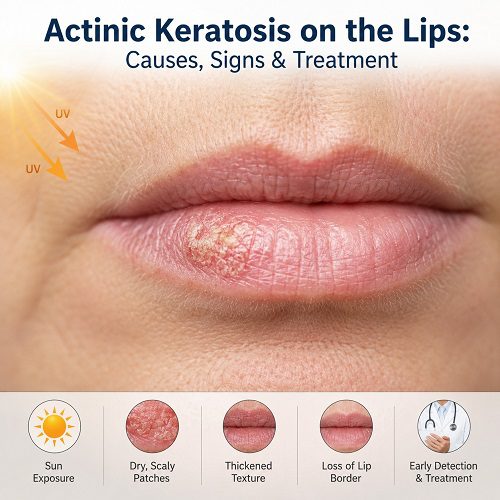
Actinic cheilitis can cause changes in the normal appearance and texture of the lip. The affected area may become persistently dry, rough, scaly or slightly thickened. The border between the lip and surrounding skin may also become less clearly defined.
Although actinic keratosis does not mean that a person has skin cancer, it indicates significant UV-related cellular damage. Some lesions may eventually develop into squamous cell carcinoma if they are left untreated.
For this reason, persistent changes on the lips should not automatically be dismissed as simple dryness or chapping.
What Causes Actinic Keratosis on Lips?
The primary cause of actinic keratosis on lips is cumulative exposure to ultraviolet radiation.
Sunlight contains UVA and UVB radiation, both of which can contribute to long-term skin damage. Repeated exposure can cause changes in the DNA of skin cells. Over time, abnormal cells may begin to grow and form areas of actinic keratosis.
The lower lip is particularly vulnerable because it is more exposed to direct sunlight than the upper lip.
Several factors can increase the likelihood of developing sun-related changes on the lips.
Long-Term Sun Exposure
Spending years outdoors without adequate lip protection increases UV exposure. People who work outdoors, participate in outdoor sports or regularly spend time in sunny environments may have a higher risk.
Fair or Light Skin
People with lighter skin generally have less natural melanin protection against UV radiation. However, people with darker skin can also develop UV-related lip damage.
Increasing Age
Actinic keratoses are more common with increasing age because UV damage accumulates throughout life. However, younger people who experience substantial sun exposure can also develop sun-related lesions.
Outdoor Occupations
Farmers, construction workers, gardeners, outdoor sports professionals and other people who spend long periods outside may receive considerable cumulative UV exposure.
Previous Sun Damage
A history of frequent sunburns or extensive sun exposure can increase the risk of developing actinic keratoses.
Tobacco Use
Smoking and other forms of tobacco exposure can contribute to poor lip health and may increase the risk of oral and lip cancers. People with persistent lip changes should discuss relevant risk factors with a healthcare professional.
Signs and Symptoms of Lip Actinic Keratosis
The appearance of lip actinic keratosis can vary from person to person. Early changes may be subtle and can easily be confused with dry or chapped lips.
Common signs include:
- Persistent dryness of the lip
- Rough or sandpaper-like texture
- Fine scaling
- Peeling that repeatedly returns
- Areas of thickened skin
- White, pale or pink patches
- Redness or inflammation
- Loss of the normal sharp border of the lip
- Persistent crusting
- Increased sensitivity or tenderness
- A feeling of tightness or burning
The lower lip is most commonly affected.
One important clue is persistence. Ordinary chapped lips generally improve when the lips are protected from cold, wind, dehydration and other irritants. A rough or scaly area that repeatedly returns despite moisturising may require professional assessment.
What Does Actinic Cheilitis Look Like?
Actinic cheilitis is a form of chronic sun-related damage affecting the lip, most often the lower lip.
It may initially appear as subtle dryness or scaling. As the condition progresses, the lip may become rougher and develop areas of thickening or discolouration.
Another characteristic feature is a change in the normal boundary between the red portion of the lip and the surrounding skin. The lip may look less clearly defined than it previously did.
Actinic cheilitis can sometimes be difficult to recognise without a clinical examination. Other conditions, including eczema, contact dermatitis, infection and persistent chapping, can produce similar symptoms.
Therefore, appearance alone cannot always establish the diagnosis.
Is Actinic Keratosis on Lips Dangerous?
Actinic keratosis is considered a precancerous condition because some lesions can progress to squamous cell carcinoma.
Not every actinic keratosis becomes cancerous, and it is not possible to predict with certainty which individual lesion will progress. However, actinic keratosis on the lips deserves particular attention because the lip is a high-risk site for squamous cell carcinoma.
A changing, persistent or increasingly thickened lesion should therefore be assessed by a dermatologist or another appropriately qualified healthcare professional.
Seek medical attention promptly if you notice:
- A sore that does not heal
- Persistent bleeding
- Increasing thickness
- A firm lump
- Rapid growth
- Significant pain
- Recurrent crusting
- Ulceration
- A persistent area that continues to change
These signs do not automatically mean cancer, but they warrant professional evaluation.
Actinic Keratosis vs Chapped Lips
It can be difficult to distinguish sun-damaged lips from ordinary chapped lips, particularly during the early stages.
Chapped lips commonly result from cold weather, dry air, wind, dehydration, frequent lip licking or irritating products. They often improve after the underlying trigger is removed and a suitable lip moisturiser is used.
Actinic keratosis, by contrast, tends to persist or repeatedly return in the same area.
A rough patch that remains for weeks, particularly on the lower lip of someone with significant lifetime sun exposure, should not simply be treated as dry skin indefinitely.
If you are unsure whether a persistent lip lesion represents chapping, dermatitis, actinic keratosis or another condition, arrange an examination with a healthcare professional.
How Is Actinic Keratosis on Lips Diagnosed?
A dermatologist will usually begin by examining the affected lip and asking about symptoms, sun exposure, previous skin lesions and relevant medical history.
The clinician may use a dermatoscope to examine the area more closely.
In some cases, a biopsy may be recommended. During a biopsy, a small sample of tissue is removed and examined under a microscope. This can help distinguish actinic keratosis from squamous cell carcinoma or another lip condition.
A biopsy may be particularly important when a lesion appears unusually thick, ulcerated, painful, bleeding or otherwise suspicious.
Treatment for Actinic Keratosis on Lips
Actinic Keratosis Treatment depends on the appearance, extent and severity of the lesion. A dermatologist may recommend one treatment or a combination of approaches.
Cryotherapy
Cryotherapy uses extremely cold temperatures, commonly liquid nitrogen, to destroy abnormal cells.
It is frequently used for individual actinic keratoses. The treated area may blister, crust or become temporarily irritated before healing.
Topical Treatments
Certain prescription creams can be used to treat actinic keratoses by targeting abnormal or damaged cells.
Examples include treatments containing medicines such as 5-fluorouracil or imiquimod. However, not all topical treatments are suitable for use on the lips, so treatment should only be undertaken according to a healthcare professional’s instructions.
Vermilionectomy
For extensive or persistent actinic cheilitis affecting the vermilion border of the lip, a specialist may consider a procedure known as a vermilionectomy.
This involves removing the affected portion of the lip’s surface tissue. It may be considered when there is significant or extensive sun damage or concern about progression.
Laser Treatment
Certain laser procedures may be used by specialists to remove or treat sun-damaged areas of the lip.
The suitability of laser treatment depends on the individual lesion and the clinician’s assessment.
Photodynamic Therapy
Photodynamic therapy (PDT) uses a light-sensitive substance followed by exposure to a specific wavelength of light. It can be used for certain types of actinic keratosis and may be considered when there are multiple affected areas.
The availability and suitability of PDT vary between patients and healthcare settings.
Surgical Removal
If a lesion is suspicious for cancer or has developed features concerning for squamous cell carcinoma, surgical removal may be recommended.
The tissue can then be examined to establish an accurate diagnosis.
Can Actinic Keratosis on Lips Be Prevented?
Although previous UV damage cannot be completely reversed, reducing future UV exposure can help protect the lips and lower the risk of additional sun-related damage.
Use Lip Sunscreen
Apply a broad-spectrum lip balm with an appropriate SPF before going outdoors. Reapply regularly, especially after eating, drinking or prolonged outdoor activity.
Wear a Wide-Brimmed Hat
A wide-brimmed hat can provide additional shade for the face and lips and reduce direct sunlight exposure.
Seek Shade
When possible, avoid prolonged exposure to intense sunlight, particularly around the middle of the day.
Avoid Tanning Beds
Artificial UV exposure can also contribute to cumulative skin damage. Avoiding tanning beds is an important part of long-term skin protection.
Have Persistent Changes Checked
Regularly examine your lips for changes in colour, texture, thickness or healing. If an abnormal area persists, arrange a professional assessment rather than assuming it is simply dry skin.
When Should You See a Dermatologist?
You should consider seeing a healthcare professional if you develop a persistent rough or scaly area on your lip, particularly if it does not improve with normal moisturising and sun protection.
Prompt assessment is especially important when the lesion:
- Continues to grow
- Becomes thicker
- Bleeds
- Forms a persistent crust
- Develops an ulcer
- Becomes painful or tender
- Does not heal
- Changes noticeably in appearance
Early assessment can help determine whether the problem is actinic keratosis, actinic cheilitis, another benign condition or a more serious lesion.
Frequently Asked Questions
Can actinic keratosis occur on the lips?
Yes. Actinic keratosis can affect sun-exposed areas of the lips, particularly the lower lip. When chronic sun damage primarily affects the lip, it is commonly called actinic cheilitis.
Is actinic cheilitis cancer?
Actinic cheilitis itself is not the same as lip cancer, but it represents chronic sun-related damage and can be associated with an increased risk of squamous cell carcinoma. Persistent or suspicious changes should therefore be examined by a healthcare professional.
Does actinic keratosis on lips go away on its own?
Some mild sun-related changes may fluctuate, but a persistent rough or scaly lesion should not be assumed to disappear on its own. Professional assessment is advisable when Actinic Keratosis symptoms persist.
Can moisturiser treat actinic keratosis?
Moisturiser may reduce dryness and discomfort but does not necessarily eliminate abnormal precancerous cells. If actinic keratosis is suspected, a healthcare professional should determine whether specific treatment is required.
How can I protect my lips from sun damage?
Use a broad-spectrum SPF lip balm, reapply it regularly, wear a hat that provides shade and avoid prolonged direct sunlight when UV levels are high.
Final Thoughts
Actinic keratosis on lips is an important sign of cumulative UV damage that should not be confused automatically with ordinary dry or chapped lips. The condition most commonly affects the lower lip and may appear as persistent roughness, scaling, dryness, thickening or changes in the normal lip border.
Because actinic keratosis and actinic cheilitis can sometimes progress to squamous cell carcinoma, persistent or changing lesions deserve professional assessment. Treatments range from cryotherapy and prescription therapies to specialist procedures for more extensive disease.
The best approach is a combination of early recognition, appropriate medical treatment and ongoing sun protection. Protecting the lips with SPF lip products, wearing protective clothing and limiting prolonged UV exposure can help reduce further sun damage.
If you notice a rough, scaly or persistently abnormal area on your lip that does not heal or repeatedly returns, speak with a dermatologist or other qualified healthcare professional for an accurate diagnosis.
Medical Disclaimer
This article is intended for general educational and informational purposes only. It is not a substitute for professional medical advice, diagnosis or treatment. If you have a persistent, changing, bleeding, painful or non-healing lesion on your lip, consult a qualified healthcare professional or dermatologist for appropriate evaluation.