 By
By Lipomas are among the most common benign soft tissue growths found beneath the skin. They are usually harmless, slow-growing, and composed of fatty tissue. Although lipomas rarely become dangerous, many people choose to have them removed because of cosmetic concerns, discomfort, pressure on nearby tissues, or uncertainty about the diagnosis.
One of the most common questions patients ask after treatment is whether a lipoma can return. Understanding lipoma recurrence is important before deciding on surgery or other Lipoma treatment options. While lipoma removal is generally successful, a small number of patients may experience lipoma regrowth or develop another lipoma near the original site.
In this comprehensive guide, we’ll explain whether lipomas come back after removal, what Lipoma causes recurrent lipoma after surgery, how often recurrence occurs, and what can be done to minimize the risk.
What is Lipoma Recurrence?
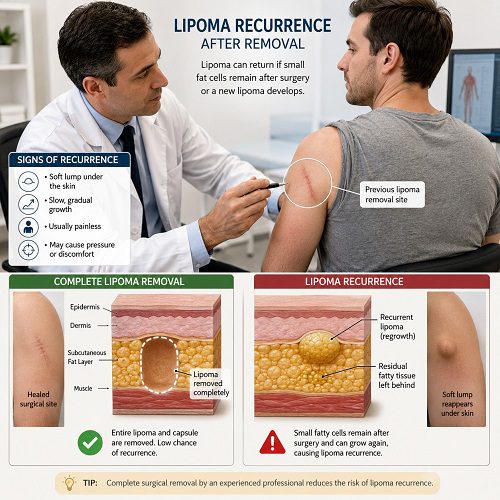
Lipoma recurrence refers to the return of a lipoma after it has been removed. The recurrence may occur at the same location or nearby tissues months or even years after treatment.
Lipoma recurrence can happen because:
- The original lipoma was not completely removed.
- Small fatty tissue remnants remain beneath the skin.
- Multiple lipomas are present due to genetic factors.
- Another lipoma develops independently near the previous site.
- Certain deep-seated lipomas are more difficult to remove completely.
Fortunately, most superficial lipomas have a very low recurrence rate when surgically removed properly.
Can Lipoma Grow Back After Removal?
The simple answer is yes—can lipoma grow back? In some cases, it can. However, lipoma regrowth is relatively uncommon after complete surgical excision.
Most lipomas do not return once entirely removed. Surgical removal usually includes both:
- The fatty mass
- Its surrounding capsule
Removing the capsule is important because it helps prevent remaining fatty tissue from growing again.
Lipoma regrowth becomes more likely if:
- The lipoma extends deeper into tissues.
- Complete removal is difficult.
- Only part of the fatty tissue is removed.
- Minimally invasive procedures leave residual tissue behind.
Patients should understand that developing a new lipoma is not always considered true recurrence. Some individuals naturally develop multiple lipomas throughout their lives.
How Common Is Lipoma Recurrence?
Lipoma recurrence after complete surgical removal is uncommon. Studies have shown that superficial lipomas have relatively low recurrence rates when treated appropriately.
Factors influencing recurrence include:
- Lipoma size
- Location
- Surgical technique
- Depth of tissue involvement
- Genetic predisposition
- Presence of multiple lipomas
Superficial lipomas generally have excellent treatment outcomes. However, deeper or infiltrating lipomas may have higher recurrence rates because complete excision can be more challenging.
What Causes Lipoma Regrowth?
Several Causes Lipoma may contribute to lipoma regrowth after treatment.
Incomplete Removal
The most common reason for recurrent lipoma after surgery is incomplete excision.
If portions of:
- Fatty tissue
- Lipoma capsule
- Deep extensions
remain beneath the skin, regrowth may occur over time.
Deep-Seated Lipomas
Some lipomas extend into:
- Muscle tissue
- Fascia
- Connective tissues
These deeper lipomas are more difficult to remove completely and may have slightly higher recurrence rates.
Multiple Lipomas
Certain individuals naturally develop:
- Multiple lipomas
- Familial multiple lipomatosis
- Recurrent fatty growths
These patients may experience new lipomas that appear close to previous surgical sites.
Genetic Factors
Genetics may influence:
- Lipoma development
- Number of lipomas
- Risk of future fatty tumors
Having family members with multiple lipomas may increase susceptibility.
Liposuction-Based Removal
Some minimally invasive procedures remove fatty tissue without completely removing the capsule. While cosmetic results may be excellent, incomplete capsule removal may increase the possibility of lipoma regrowth in selected cases.
Signs of Recurrent Lipoma After Surgery
Recognizing the early signs of recurrence allows timely evaluation.
Symptoms may include:
- Small soft lump beneath the skin
- Slow enlargement over time
- Mild tenderness
- Pressure sensation
- Cosmetic concerns
- Mobile fatty mass
A recurrent lipoma usually resembles the original growth.
Patients should consult their healthcare provider if they notice:
- Rapid enlargement
- Persistent pain
- Skin changes
- Firm or irregular masses
- Recurrence shortly after surgery
Further evaluation may be necessary to confirm the Lipoma diagnosis.
How Long Does Lipoma Recurrence Take?
Lipoma recurrence does not follow a specific timeline.
Lipoma regrowth may occur:
- Several months later
- One to two years after surgery
- Multiple years afterward
Some patients never experience recurrence.
The timing often depends upon:
- Surgical completeness
- Lipoma size
- Individual risk factors
- Tissue involvement
Slow growth remains one of the hallmark features of recurrent lipomas.
Are Some Lipomas More Likely to Return?
Yes. Certain types of lipomas carry slightly higher risks of recurrence.
These include:
Intramuscular Lipomas
These develop within muscle tissue and can infiltrate surrounding structures.
They may:
- Extend deeply
- Be difficult to remove completely
- Have higher recurrence rates
Large Lipomas
Large fatty tumors occasionally possess:
- Irregular borders
- Deep extensions
- Multiple lobules
These characteristics can complicate removal procedures.
Multiple Lipomas
Individuals with multiple lipomas may continue developing new growths throughout life.
Deep Lipomas
Deep soft tissue lipomas require careful surgical planning and sometimes imaging studies before removal.
Does Surgical Removal Prevent Recurrence?
Complete surgical excision remains the gold standard treatment for most lipomas.
Advantages include:
- Complete fatty tissue removal
- Capsule removal
- Lower recurrence rates
- Tissue examination if necessary
- Excellent long-term outcomes
Proper surgical removal significantly reduces the likelihood of lipoma recurrence.
Can Lipoma Grow Back After Liposuction?
Liposuction is sometimes used for:
- Cosmetic purposes
- Large lipomas
- Selected treatment situations
However, liposuction may not always remove:
- The capsule
- Deep fatty tissue
- Small residual fragments
Because of this, some patients may experience lipoma regrowth after minimally invasive procedures.
Traditional surgical excision generally offers lower recurrence rates when complete removal is achieved.
How Is Lipoma Recurrence Diagnosed?
Diagnosis usually begins with a physical examination.
Healthcare providers may assess:
- Lump size
- Texture
- Mobility
- Surgical history
- Growth pattern
Imaging studies may occasionally include:
Ultrasound
Ultrasound can help evaluate:
- Fatty masses
- Tissue characteristics
- Depth of involvement
MRI
MRI may be recommended for:
- Deep lipomas
- Intramuscular lipomas
- Large recurrent masses
CT Scan
Selected cases may benefit from CT imaging when deeper structures are involved.
Treatment Options for Recurrent Lipoma
Treatment depends upon:
- Size
- Symptoms
- Growth rate
- Cosmetic concerns
- Diagnostic uncertainty
Observation
Small recurrent lipomas that are:
- Painless
- Stable in size
- Not bothersome
may simply be monitored periodically.
Surgical Removal
Repeat surgical excision remains the most effective Lipoma treatment for recurrent lipoma after surgery.
Benefits include:
- Complete removal
- Reduced future recurrence risk
- Tissue examination when indicated
Advanced Surgical Planning
Large or deep lipomas may require:
- Imaging guidance
- Specialized surgical techniques
- Careful tissue dissection
Can Lifestyle Changes Prevent Lipoma Recurrence?
No lifestyle modification can completely prevent lipoma recurrence. Lipomas are not usually caused by:
- Poor Lipoma diet
- Lack of exercise
- Obesity
However, maintaining overall health remains beneficial.
Healthy habits include:
- Regular physical activity
- Balanced nutrition
- Routine medical follow-up
- Monitoring skin changes
Patients should avoid attempting self-removal or unproven treatments that may delay proper medical evaluation.
Is Lipoma Recurrence Dangerous?
Most recurrent lipomas remain benign and harmless.
They typically:
- Grow slowly
- Cause minimal symptoms
- Respond well to treatment
However, medical evaluation becomes important when a lump demonstrates:
- Rapid growth
- Persistent pain
- Hard texture
- Fixation to surrounding tissues
- Significant size changes
Healthcare providers may recommend additional testing when symptoms are atypical.
When Should You See a Doctor?
Seek medical evaluation if you notice:
- Lipoma regrowth after surgery
- New lumps beneath the skin
- Painful swelling
- Rapid enlargement
- Cosmetic concerns
- Multiple recurring lipomas
Early assessment helps confirm whether the growth represents:
- Lipoma recurrence
- New lipoma formation
- Another soft tissue condition
Reducing the Risk of Lipoma Regrowth
Although recurrence cannot always be prevented, several strategies may reduce the risk.
These include:
- Choosing complete surgical excision when appropriate.
- Following post-operative instructions carefully.
- Scheduling follow-up appointments.
- Monitoring the surgical site regularly.
- Seeking evaluation for unusual symptoms promptly.
For larger or deeper lipomas, imaging studies before surgery may improve treatment planning and help ensure complete removal.
Frequently Asked Questions
Can lipoma grow back after surgery?
Yes, although complete surgical removal greatly reduces recurrence risk.
How common is lipoma recurrence?
Recurrence is uncommon for most superficial lipomas when completely excised.
Is recurrent lipoma after surgery dangerous?
Most recurrent lipomas remain benign. Rapidly growing or painful masses should be evaluated promptly.
Can exercise prevent lipoma regrowth?
Lipoma Exercise supports overall health but has not been shown to prevent lipoma recurrence.
Are multiple lipomas hereditary?
Some inherited conditions may predispose individuals to developing multiple lipomas.
Can lipoma regrowth occur years later?
Yes. Lipoma recurrence may occur months or years following treatment.
Conclusion
Lipoma recurrence is relatively uncommon after complete surgical removal, but it remains possible in certain situations. Factors such as incomplete excision, deep tissue involvement, multiple lipomas, and genetic predisposition may contribute to lipoma regrowth. While many patients never experience recurrent lipoma after surgery, understanding the warning signs can help ensure timely medical evaluation when needed.
If you’ve ever wondered, can lipoma grow back, the answer is yes—but complete surgical excision offers excellent long-term outcomes for most patients. Monitoring changes beneath the skin and maintaining regular follow-up with your healthcare provider are the best ways to address any concerns promptly. With proper treatment and ongoing observation, most lipomas can be managed successfully with minimal risk of recurrence.
Disclaimer:
This article is for educational purposes only and should not replace professional medical advice, diagnosis, or treatment. Always consult a qualified healthcare provider regarding any new or changing scalp or forehead lump.