 By
By Actinic keratosis (AK) is a common skin condition caused by long-term ultraviolet (UV) exposure. It usually appears as a rough, scaly, or crusty patch on sun-exposed skin such as the face, scalp, ears, neck, or backs of the hands. Although an individual actinic keratosis is not necessarily skin cancer, some can progress to squamous cell carcinoma, a type of skin cancer.
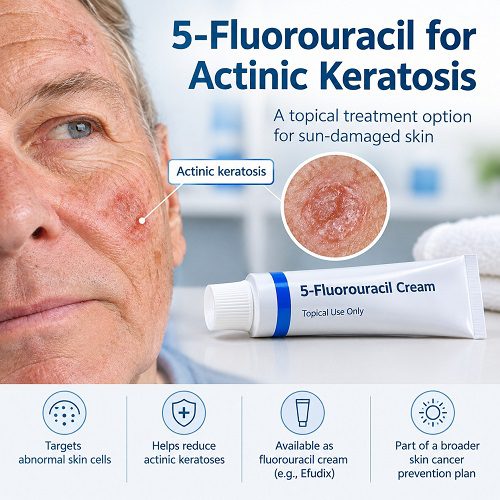
One commonly prescribed treatment is 5-fluorouracil for actinic keratosis. This medication, often called 5-FU, is a topical antimetabolite that targets abnormal, rapidly dividing skin cells. Depending on the product and country, it may be available in different concentrations and under different brand names. Efudix is one brand name for topical 5-fluorouracil in some countries, while other markets use names such as Efudex or generic fluorouracil.
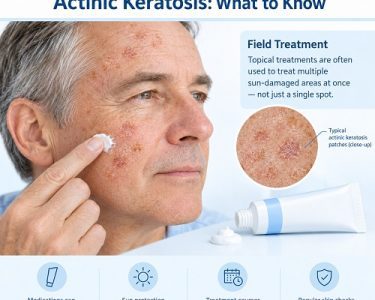
Unlike a treatment that simply freezes or removes one visible spot, fluorouracil can be used as a field treatment. This means it can be applied to an area containing both visible actinic keratoses and areas of sun-damaged skin where abnormal cells may not yet be obvious.
What Is Actinic Keratosis?
What Is Actinic Keratosis? Actinic keratosis is a rough, abnormal area of skin that develops after cumulative UV damage. The lesions can be flat or raised and may be skin-colored, pink, red, white, or yellowish. Some feel rough or gritty when touched even when they are difficult to see.
AKs most commonly develop on areas that receive repeated sun exposure, including:
- Actinic Keratosis on the Face and forehead
- Actinic Keratosis on the Ears
- Actinic Keratosis on the Scalp, particularly in people with thinning or no hair
- Actinic Keratosis on the Neck
- Actinic Keratosis on the Hands
- Forearms
- Lower legs
- Other chronically sun-exposed areas
A dermatologist or other qualified healthcare professional should assess suspicious lesions because some skin cancers can resemble actinic keratoses. A biopsy may sometimes be necessary, especially when a lesion is thick, rapidly changing, ulcerated, bleeding, painful, or not responding as expected to treatment.
What Is 5-Fluorouracil?
5-fluorouracil, commonly abbreviated as 5-FU, is a medication that interferes with processes required for cell growth. When applied to the skin, it preferentially affects abnormal cells in sun-damaged areas.
Topical fluorouracil has been used to treat actinic keratoses for decades. The American Academy of Dermatology includes topical 5-fluorouracil among the strongly recommended treatment options for actinic keratosis.
The medication is available in several formulations and strengths. For example, current U.S. labeling includes a 0.5% formulation used once daily for certain actinic keratoses, while other fluorouracil products, including 5% cream, have different dosing instructions.
This is important because you should not assume that every fluorouracil cream is used in the same way. The correct amount, concentration, frequency, treatment area, and duration depend on the prescribed product and your clinician’s instructions.
How Does 5-Fluorouracil Work for Actinic Keratosis?
The main purpose of 5-fluorouracil for actinic keratosis is to destroy abnormal, sun-damaged cells.
When fluorouracil is applied to an affected area, abnormal cells are particularly sensitive to its effects. As treatment progresses, the treated skin may become increasingly red, irritated, scaly, crusted, or sore. This reaction can look alarming, but an inflammatory response is an expected part of treatment.
The FDA-approved information for EFUDEX 5% describes a progression that can include redness followed by blistering, peeling, erosion, and eventual regrowth of healthy skin. For actinic keratoses, the historical EFUDEX labeling describes treatment commonly lasting approximately two to four weeks, although treatment instructions depend on the specific product and individual circumstances.
In other words, fluorouracil is not designed to make the skin look better immediately. The treatment deliberately creates a controlled inflammatory reaction in the treated area.
What Is Fluorouracil Cream Used For?
Fluorouracil cream is most commonly used topically for actinic or solar keratoses. Certain formulations may also have other approved or specialist uses.
For actinic keratosis, fluorouracil can be particularly useful when several lesions occur within the same sun-damaged area. Instead of treating each visible lesion separately, a clinician may recommend field treatment over an appropriate area of skin.
Research has demonstrated the effectiveness of topical fluorouracil for reducing actinic keratoses. In a randomized clinical trial involving high-risk patients, a course of 5% fluorouracil applied to the face and ears resulted in fewer AKs and fewer subsequent spot treatments over more than two years of follow-up compared with control cream.
However, these results should not be interpreted as meaning that fluorouracil permanently prevents every future actinic keratosis. UV-related skin damage is cumulative, and new lesions can develop later.
What Is Efudix?
Efudix is a brand name used for topical 5-fluorouracil cream in some countries, including New Zealand. The active ingredient is fluorouracil, commonly abbreviated as 5-FU.
People sometimes use the terms “Efudix,” “fluorouracil cream,” and “5-FU cream” interchangeably. However, brand names and available strengths differ internationally.
If you have been prescribed Efudix or another fluorouracil product, follow the instructions supplied with that particular medicine. Do not substitute another strength or product without discussing it with your doctor or pharmacist.
What Should You Expect During Treatment?
Knowing what to expect can make a topical Actinic Keratosis treatment much easier to manage.
The exact response varies between people, but treatment commonly follows a general pattern.
Early treatment
During the first several days, you may notice little change or only mild redness and irritation.
As the medication begins affecting abnormal cells, treated areas can become more visibly inflamed.
Increasing redness and scaling
After several days, the skin may become red, dry, rough, scaly, itchy, tender, or burning.
Sun-damaged areas may react more strongly than surrounding normal skin. This is one reason field treatment can make previously subtle areas of damage much more noticeable.
Crusting and erosion
With continued treatment, some areas may become crusted, sore, or eroded. In some patients, the reaction can become quite pronounced.
DermNet notes that burning or stinging is common and that redness, scaling, tenderness, crusting, and erosions can occur during treatment.
Healing after treatment
After the prescribed course is completed, the inflammatory reaction gradually settles. The skin may remain pink or sensitive for a while before returning closer to its usual appearance.
Healing is not necessarily immediate. The MedlinePlus drug information notes that although treatment of actinic keratoses often takes about two to four weeks, complete healing may take another one to two months after treatment stops.
Is Redness a Sign That Fluorouracil Is Working?
Often, yes—but redness alone should not be used to determine whether treatment is working or whether you should continue.
Fluorouracil commonly causes inflammation in treated areas, and the response can become increasingly noticeable during treatment. However, individual reactions differ considerably.
A mild reaction does not automatically mean the medication is ineffective, and a severe reaction does not necessarily mean that the treatment is more effective.
Your prescriber should determine how long you should continue treatment. Do not deliberately extend treatment or increase the amount of cream because you believe a stronger reaction will produce a better result.
How Long Does 5-Fluorouracil Treatment Take?
There is no single treatment duration that applies to everyone.
For example, the FDA labeling for EFUDEX 5% historically describes twice-daily treatment for actinic or solar keratoses, with a usual duration of approximately two to four weeks.
A current U.S. FDA label for a 0.5% fluorouracil cream specifies once-daily application for up to four weeks for the labeled treatment of actinic keratoses.
These differences demonstrate why the instructions on your specific prescription matter. Treatment schedules can differ according to formulation, strength, location, severity, and the clinician’s treatment plan.
How Is Fluorouracil Cream Applied?
Your doctor or pharmacist should provide product-specific instructions.
In general, topical fluorouracil is applied as a thin layer to the prescribed treatment area. Some formulations are applied once daily, while others may be prescribed twice daily.
MedlinePlus advises using fluorouracil exactly as directed and not applying more, less, or more frequently than prescribed. It also recommends washing your hands thoroughly after application when the fingers are used to apply the medicine.
Unless specifically instructed otherwise, fluorouracil should not be applied to the eyes, eyelids, mouth, or other sensitive areas. Avoid accidental transfer to these areas.
Do not cover the treated skin with an occlusive dressing unless your healthcare professional specifically instructs you to do so, because occlusion can increase penetration and potentially increase irritation.
Common Side Effects
Because fluorouracil is intended to act on abnormal cells in the treated area, local skin reactions are common.
Possible reactions include:
- Redness
- Burning or stinging
- Itching
- Dryness
- Scaling
- Tenderness
- Swelling
- Crusting
- Erosion
- Increased sensitivity
The intensity of the reaction can depend on the amount of sun damage, the treatment area, the product used, and individual sensitivity.
If the reaction becomes unexpectedly severe, contact your healthcare professional rather than deciding independently whether to stop or continue treatment.
When Should You Contact Your Doctor?
Contact your clinician if you develop a reaction that seems unusually severe or if you are concerned about infection, extensive blistering, significant swelling, severe pain, or other unexpected Actinic Keratosis symptoms.
You should also seek medical assessment if an apparent actinic keratosis becomes rapidly larger, persistently painful, thickened, ulcerated, or bleeds.
These features can sometimes indicate a lesion that needs further assessment rather than continued self-treatment.
Fluorouracil is also associated with important precautions. For example, current FDA labeling for 0.5% fluorouracil states that it should not be used during pregnancy and should not be used by people with known dihydropyrimidine dehydrogenase (DPD) deficiency because of the risk of serious toxicity.
Tell your healthcare professional if you are pregnant, planning pregnancy, breastfeeding, or have been diagnosed with DPD deficiency before using topical fluorouracil.
Does Fluorouracil Remove All Actinic Keratoses?
Fluorouracil can substantially reduce actinic keratoses in appropriately selected patients, but no treatment guarantees that every lesion will disappear permanently.
In clinical research involving 5% fluorouracil treatment of the face and ears, complete clearance occurred in a proportion of patients, and treated participants had fewer AKs over subsequent follow-up.
Some lesions may remain and require another treatment. A dermatologist may use cryotherapy, another Topical Treatments for Actinic Keratosis, photodynamic therapy, curettage, biopsy, or another approach depending on the lesion.
Importantly, a persistent lesion should not simply be treated repeatedly without assessment. Some skin cancers can resemble actinic keratoses, and an apparently resistant lesion may need a biopsy or another form of evaluation.
5-Fluorouracil Compared With Other Actinic Keratosis Treatments
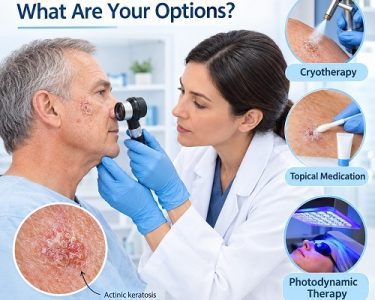
There are several approaches to treating actinic keratoses.
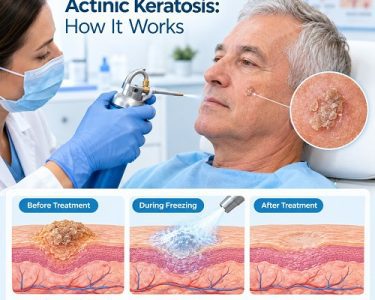
Cryotherapy uses extreme cold to destroy individual lesions and is often useful when only a small number of discrete lesions are present.
Topical treatments such as fluorouracil and imiquimod can be used for field treatment when multiple lesions occur across an area of sun-damaged skin.
Photodynamic therapy (PDT) uses a photosensitizing medication followed by a specific light source to treat affected skin.
Other treatments, including tirbanibulin and diclofenac in appropriate circumstances, may also be considered. The American Academy of Dermatology recognizes several effective treatment approaches and strongly recommends UV protection alongside appropriate treatment.
The appropriate treatment depends on the number and thickness of lesions, their location, previous treatment, skin characteristics, medical history, and patient preferences.
Sun Protection Still Matters
Treating an actinic keratosis does not erase the underlying history of UV exposure.
Sun protection should remain part of your long-term skin-care routine. Practical measures include seeking shade, wearing protective clothing and a wide-brimmed hat when appropriate, and using broad-spectrum sunscreen as directed.
Reducing ongoing UV exposure can help limit additional sun damage and the development of new actinic keratoses. The American Academy of Dermatology includes UV protection as a strong recommendation in its actinic keratosis guideline.
What Happens After Treatment?
After the prescribed course ends, the treated skin gradually heals. It may remain pink or sensitive for several weeks.
Your clinician may recommend a gentle moisturizer or another product during the healing phase. DermNet notes that healthy new skin generally replaces treated damaged skin over the weeks following treatment, although residual redness or sensitivity can sometimes last longer.
Follow-up is important, especially if you have extensive sun damage or a history of skin cancer. New or changing lesions should be assessed rather than assumed to be another actinic keratosis.
An Important Safety Point for Pet Owners
Topical fluorouracil can be extremely dangerous to pets if accidentally ingested.
The FDA has reported serious illnesses and deaths in pets following accidental exposure to prescription fluorouracil. Exposure can occur if a pet chews the tube or licks recently treated skin.
Keep the medication securely stored and prevent pets from licking treated areas. Wash your hands thoroughly after application and follow your product’s storage instructions.
Frequently Asked Questions
Is 5-fluorouracil effective for actinic keratosis?
Yes. Topical 5-fluorouracil is an established treatment for actinic keratosis and is strongly recommended as a treatment option in American Academy of Dermatology guidelines.
How painful is fluorouracil treatment?
Some people experience only mild irritation, while others develop substantial burning, tenderness, crusting, or erosion. The response varies according to the person, treatment area, product, and amount of sun damage.
How long does the redness last?
Redness and irritation usually improve after treatment is stopped, but healing can take several weeks. Complete healing after an actinic keratosis treatment course may take one to two months or longer in some circumstances.
Can I use moisturizer while using fluorouracil?
Ask your healthcare professional which moisturizer or healing product is appropriate for your treatment plan. Avoid applying additional products to the treatment area unless your clinician or product instructions allow them.
Is Efudix the same as fluorouracil?
Efudix is a brand name for topical fluorouracil in some countries. However, different brands and formulations can have different strengths and instructions, so always check the specific product you have been prescribed.
Can actinic keratosis come back after treatment?
Yes. Treatment removes or reduces existing abnormal areas but does not make previously sun-damaged skin permanently immune to future actinic keratoses. Continued sun protection and periodic skin checks remain important.
Final Thoughts
5-fluorouracil for actinic keratosis is a well-established field treatment that can be particularly useful when multiple sun-damaged lesions occur within the same area. Rather than simply removing one visible spot, fluorouracil can treat abnormal cells across a prescribed field of skin.
The treatment is also different from many cosmetic creams. Redness, scaling, tenderness, crusting, and irritation can be expected parts of the process, and the skin may look worse before it looks better.
The exact instructions matter. Fluorouracil comes in different strengths and formulations, and treatment schedules can vary. For that reason, patients should use their prescribed product exactly as directed rather than copying another person’s regimen.
If you have actinic keratoses, a dermatologist or other qualified healthcare professional can determine whether fluorouracil is appropriate and whether a lesion needs a different treatment or biopsy.
Most importantly, treatment should be accompanied by ongoing sun protection and attention to new or changing skin lesions. Actinic keratosis is a marker of cumulative sun damage, so long-term skin surveillance remains an important part of care.