
 By
By Abdominal adhesions are bands of scar tissue that can form inside the abdomen after surgery, infection, inflammation, or other types of tissue injury. They may connect organs that normally move freely or cause sections of the intestine to stick together. Many people with adhesions have no symptoms, but in some cases, they can contribute to chronic abdominal discomfort, restricted movement of the intestines, or bowel obstruction.
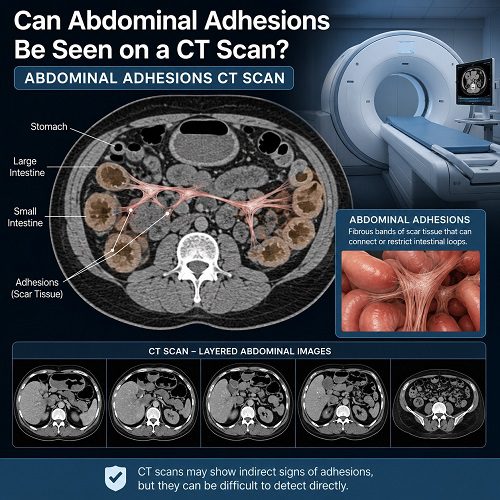
One common question is: Can abdominal adhesions be seen on a CT scan?
The answer is somewhat complicated. A CT scan can provide valuable information about the abdomen and may show signs that suggest adhesions or complications caused by them. However, adhesions themselves are often difficult to see directly on routine CT imaging. In many cases, doctors diagnose them based on a combination of symptoms, medical history, physical examination, and imaging findings.
Understanding what a CT scan can and cannot show can make the process of adhesion diagnosis easier to understand.
What Are Abdominal Adhesions?
What Are Abdominal Adhesions? Abdominal adhesions are bands of fibrous scar tissue that develop inside the abdominal cavity. They can form between loops of the small intestine, between the intestine and abdominal wall, or between the intestine and other organs.
Normally, abdominal organs have smooth surfaces that allow them to move against each other. When inflammation or injury occurs, the body’s healing process can produce scar tissue. Sometimes, this scar tissue creates abnormal connections between tissues or organs.
Common Abdominal Adhesions causes include:
- Previous abdominal or pelvic surgery
- Infections inside the abdomen
- Appendicitis
- Diverticulitis
- Inflammatory bowel conditions
- Endometriosis
- Radiation therapy
- Abdominal trauma
- Other inflammatory conditions
Not everyone with adhesions develops symptoms. Some people may have adhesions for years without knowing they are present.
Can Abdominal Adhesions Be Seen on a CT Scan?
A CT scan does not always show abdominal adhesions directly.
This is one of the most important points to understand when discussing an Abdominal Adhesions CT Scan. Adhesions are usually thin, fibrous bands of tissue, and many are not easily distinguishable from surrounding abdominal structures on standard CT images.
However, CT scans can sometimes reveal indirect signs of adhesions. For example, a radiologist may identify unusual positioning of bowel loops, areas where bowel segments appear fixed, or evidence of obstruction that may be caused by an adhesive band.
Therefore, a CT scan can be extremely useful even when the adhesion itself is not clearly visible.
How CT Scans Help With Adhesion Diagnosis
CT imaging uses X-rays and computer processing to create detailed cross-sectional images of the body. It allows doctors to evaluate the intestines, abdominal organs, blood vessels, and surrounding tissues.
When abdominal adhesions are suspected, a CT scan may help doctors determine whether symptoms are caused by something more obvious, such as:
- Small bowel obstruction
- Large bowel obstruction
- Inflammation
- Abscesses
- Perforation
- Hernias
- Tumors
- Severe infection
- Other structural abnormalities
This is important because abdominal pain and digestive symptoms can have many Abdominal Adhesions causes.
Instead of simply asking whether an adhesion is visible, doctors often use CT imaging to answer a broader question: Is there an abnormal process occurring inside the abdomen that could explain the patient’s symptoms?
What Does an Adhesion Look Like on CT?
There is no single appearance that identifies every abdominal adhesion.
Some adhesions may be suggested by subtle abnormalities in the normal arrangement of abdominal structures. A radiologist may notice that bowel loops are unusually positioned, clustered, angulated, or tethered.
Other findings may become more apparent when adhesions cause bowel obstruction.
For example, CT imaging may show:
- Dilated sections of small intestine
- A transition point where dilated bowel becomes collapsed
- Abnormal angulation of bowel loops
- Clustering of intestinal loops
- Changes in the normal position of bowel
- Fluid-filled bowel segments
- Reduced passage of intestinal contents
- Other signs associated with obstruction
These findings do not necessarily prove that adhesions are present. Instead, they may provide clues about the underlying cause.
Why Adhesions Can Be Difficult to Detect
Adhesions are challenging to visualize because they are often thin and made of fibrous tissue. They may blend with surrounding tissues and may not create a strong contrast on routine imaging.
Another reason is that adhesions are dynamic. The intestines normally move within the abdomen. An adhesive band can restrict that movement, but the resulting abnormality may be subtle when the scan is performed.
The size, location, thickness, and severity of an adhesion can also influence whether it is detectable.
For these reasons, a normal CT scan does not necessarily mean that a person has no adhesions.
When CT Scans Are Especially Helpful
Although CT may not directly demonstrate every adhesion, it becomes particularly valuable when doctors suspect a complication.
Bowel Obstruction
One of the most important complications associated with abdominal adhesions is intestinal or bowel obstruction.
An adhesive band can pull or compress a section of intestine, preventing the normal movement of food, fluid, and gas through the digestive tract.
A CT scan can often identify the presence and severity of bowel obstruction and may help doctors locate the area where the blockage occurs.
Possible symptoms include:
- Cramping abdominal pain
- Abdominal swelling or bloating
- Nausea
- Vomiting
- Constipation
- Inability to pass gas
- Abdominal tenderness
A suspected bowel obstruction requires prompt medical evaluation because a severe blockage can potentially compromise blood flow to the intestine.
Complications
CT imaging can also help doctors look for complications associated with obstruction, including signs of reduced blood supply, perforation, inflammation, or infection.
These findings can help determine whether conservative management is appropriate or whether urgent treatment may be necessary.
Does a Normal CT Scan Rule Out Abdominal Adhesions?
No.
A normal CT scan cannot always rule out adhesions.
If an adhesion is small and is not causing a significant structural abnormality, it may not be visible. A person can therefore have adhesions even when CT imaging does not identify them.
This is why doctors consider the entire clinical picture.
A patient’s surgical history can be particularly important. Someone who has undergone previous abdominal surgery may have a higher likelihood of developing adhesions. If that person later develops recurrent abdominal pain or symptoms of bowel obstruction, adhesions may be considered as one possible cause.
What Other Tests May Be Used?
CT is only one part of abdominal imaging and diagnostic evaluation.
Depending on the Abdominal Adhesions symptoms, doctors may use other tests to investigate abdominal problems.
Abdominal X-Ray
A conventional abdominal X-ray can sometimes show signs of bowel obstruction. It is less detailed than CT but may be useful in certain situations.
Ultrasound
Ultrasound uses sound waves rather than radiation. It can be useful for evaluating certain abdominal organs and conditions, although it is generally limited in directly identifying many adhesions.
MRI
MRI provides detailed soft-tissue images without using ionizing radiation. Specialized MRI techniques may sometimes provide additional information, depending on the suspected condition and location of the adhesions.
Diagnostic Laparoscopy
In some cases, adhesions are ultimately confirmed during surgery, particularly when surgical treatment is already necessary.
Laparoscopy involves inserting a small camera through an incision to directly view structures inside the abdomen.
Because it is an invasive procedure, it is not normally performed simply to look for asymptomatic adhesions.
How Doctors Diagnose Abdominal Adhesions
There is no single test that reliably detects every abdominal adhesion.
An adhesion diagnosis may involve several steps.
Medical History
Doctors may ask about:
- Previous abdominal surgeries
- Pelvic surgeries
- Previous infections
- Inflammatory diseases
- Cancer treatments
- Previous bowel obstruction
- Abdominal trauma
- The timing and pattern of symptoms
A history of abdominal surgery can be an important clue because postoperative adhesions are common.
Physical Examination
A physical examination may help doctors identify tenderness, swelling, abdominal distension, or other findings.
However, physical examination alone cannot confirm the presence of adhesions.
Imaging
Imaging is often used to investigate symptoms and rule out other causes.
CT may be particularly important when bowel obstruction is suspected because it can provide detailed information about the intestine and surrounding structures.
Surgical Findings
In some circumstances, adhesions are confirmed when a surgeon directly observes them during an abdominal operation.
However, surgery is not usually recommended solely for diagnosing Abdominal Adhesions because surgery itself can cause additional scar tissue.
Abdominal Adhesions After Surgery
Previous abdominal surgery is one of the most important risk factors for developing adhesions.
During surgery, tissues inside the abdomen can become irritated or inflamed as part of the normal healing process. Scar tissue may subsequently develop.
Adhesions can occur after procedures involving the:
- Appendix
- Gallbladder
- Intestines
- Stomach
- Colon
- Reproductive organs
- Pelvis
Some people never experience problems from postoperative adhesions. Others may develop symptoms months or even years after an operation.
If symptoms develop after previous surgery, doctors may consider adhesions among several possible explanations.
Symptoms That May Lead to a CT Scan
A doctor may order abdominal imaging when a person has unexplained or concerning symptoms.
Symptoms that may prompt evaluation include:
- Persistent abdominal pain
- Recurrent cramping
- Significant bloating
- Abdominal distension
- Nausea or vomiting
- Changes in bowel movements
- Difficulty passing gas
- Unexplained digestive symptoms
- Symptoms suggesting bowel obstruction
The decision to perform CT imaging depends on the person’s symptoms, examination findings, medical history, and clinical situation.
CT With Contrast vs. CT Without Contrast
Depending on what doctors are trying to investigate, a CT scan may be performed with or without contrast.
Contrast material can help make certain organs, blood vessels, and abnormal areas easier to distinguish.
The choice depends on factors such as:
- The suspected diagnosis
- The patient’s medical history
- Kidney function
- Previous reactions to contrast
- Whether bowel or vascular complications are suspected
- The specific CT protocol being used
Patients should tell their healthcare team about previous contrast reactions, kidney problems, pregnancy, and other relevant medical information before the examination.
What Happens If Adhesions Are Suspected?
If imaging and symptoms suggest that adhesions may be contributing to a problem, treatment depends on the severity and nature of the symptoms.
People who have adhesions without symptoms generally do not need treatment.
If adhesions cause bowel obstruction or another serious complication, medical treatment may be necessary.
Abdominal Adhesions Treatment can include observation and supportive care in selected cases or surgery when the obstruction does not resolve or complications develop.
Surgery to cut or release adhesions is called adhesiolysis.
However, surgery has an important limitation: it can create new scar tissue and potentially lead to additional adhesions. Therefore, doctors carefully weigh the potential benefits and risks before recommending an operation.
When Should You Seek Urgent Medical Care?
Severe or rapidly worsening abdominal symptoms should not be ignored.
Seek urgent medical evaluation if you experience symptoms such as:
- Severe or persistent abdominal pain
- Repeated vomiting
- Significant abdominal swelling
- Inability to pass stool or gas
- Fever associated with severe abdominal symptoms
- Fainting or marked weakness
- Signs of dehydration
- Increasing abdominal tenderness
These symptoms can occur with bowel obstruction and other potentially serious abdominal conditions.
A CT scan may be part of the urgent evaluation when doctors suspect an obstruction or another complication.
Frequently Asked Questions
Can a CT scan definitely diagnose abdominal adhesions?
Not always. CT scans may show indirect signs of adhesions or complications such as bowel obstruction, but many adhesions cannot be directly visualized.
What is the best scan for abdominal adhesions?
There is no single imaging test that detects every adhesion. CT is highly useful for evaluating complications, particularly bowel obstruction. In selected situations, MRI or other imaging techniques may provide additional information.
Can adhesions cause abdominal pain even if the CT scan is normal?
Yes. Small or uncomplicated adhesions may not be visible on routine CT. Persistent symptoms should therefore be evaluated based on the complete clinical picture rather than one imaging result.
Can adhesions cause bowel obstruction?
Yes. Adhesions are an important cause of small bowel obstruction. An adhesive band can restrict or compress the intestine and interfere with the movement of intestinal contents.
Does surgery remove all abdominal adhesions?
No. Surgery can release existing adhesions, but new adhesions can form as part of the healing process. Doctors therefore recommend adhesiolysis selectively.
Conclusion
So, can abdominal adhesions be seen on a CT scan? Sometimes, but not always.
The key point is that CT imaging is often better at identifying the effects of adhesions than directly showing the thin scar-tissue bands themselves. A CT scan can reveal bowel obstruction, abnormal bowel positioning, intestinal dilation, inflammation, and other findings that may suggest adhesions.
An Abdominal Adhesions CT Scan can therefore be an important part of an overall diagnostic evaluation, especially when symptoms raise concern about bowel obstruction or another abdominal complication. However, a normal CT does not necessarily rule out adhesions.
Effective adhesion diagnosis usually combines medical history, symptoms, physical examination, imaging, and, in selected circumstances, direct visualization during surgery. If you have persistent abdominal pain, recurrent digestive symptoms, or signs of bowel obstruction—especially after previous abdominal surgery—talk with a healthcare professional about appropriate evaluation.