
 By
By A lipoma on arm is one of the most common benign (non-cancerous) soft tissue growths. Many people first notice a small, soft lump beneath the skin while getting dressed, exercising, or simply touching their arm or shoulder. Although finding a lump can be alarming, most lipomas are harmless and grow very slowly over time.
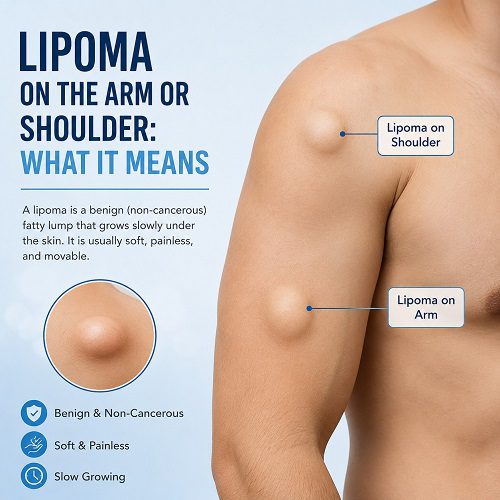
A lipoma is made up of fatty tissue that collects beneath the skin. It can appear almost anywhere on the body, but the upper arms, forearms, shoulders, back, Lipoma Neck, and thighs are among the most common locations. A lipoma on shoulder often feels soft, moves slightly when pressed, and usually lipoma causes little to no pain unless it presses against nearby nerves or tissues.
What Is a Lipoma?
A lipoma is a slow-growing collection of fat cells enclosed within a thin, fibrous capsule. Unlike cancerous tumors, lipomas do not spread to other parts of the body and rarely become dangerous.
They typically develop just beneath the skin and have several characteristic features:
- Soft and doughy texture
- Round or oval shape
- Easily movable under the skin
- Usually painless
- Slow growth over months or years
A lipoma on arm may range in size from less than an inch to several inches across. Some remain the same size for years, while others gradually enlarge.
Why Does a Lipoma Develop on the Arm?
The exact cause remains unknown, but researchers believe several factors contribute to lipoma formation.
Genetics
Many individuals inherit a tendency to develop lipomas. If close family members have them, your chances are higher.
Minor Injury
Although not proven, some people notice a lump on arm lipoma appearing after a minor injury or bruise. Trauma is not believed to directly cause lipomas but may draw attention to an existing lump.
Age
Lipomas most commonly develop between ages 40 and 60, although they can occur at any age.
Obesity
Being overweight does not directly cause lipomas, but fatty tissue distribution may make them easier to notice.
Certain Medical Conditions
Rare inherited disorders increase the likelihood of developing multiple lipomas, including:
- Familial multiple lipomatosis
- Madelung disease
- Dercum disease
- Gardner syndrome
Why Are the Arm and Shoulder Common Locations?
The arms and shoulders contain a healthy layer of fatty tissue beneath the skin. Since lipomas develop from fat cells, these areas naturally become common sites.
A lipoma on shoulder often appears over the upper shoulder near the deltoid muscle, while arm lipomas may develop on:
- Upper arm
- Forearm
- Near the elbow
- Lipoma Back of the arm
- Inner arm
These locations make the lump easier to notice during daily activities.
Symptoms of Lipoma on Arm
Most people experience very few symptoms.
Typical signs include:
Soft Lump
The lump feels soft rather than hard.
Movable
It slides slightly beneath the skin when gently pushed.
Slow Growth
Lipomas usually enlarge very gradually over several years.
Painless
Most remain painless unless they compress nearby nerves.
Round Shape
The edges are generally smooth and well-defined.
A soft lump on shoulder that matches these characteristics is often a lipoma, but only a healthcare provider can confirm the diagnosis.
How Big Can a Lipoma Become?
Most lipomas measure between 1 and 5 centimeters.
However, some grow much larger.
Small lipomas:
- Less than 2 cm
Medium lipomas:
- 2–5 cm
Large lipomas:
- More than 5 cm
Rare giant lipomas can exceed 10 centimeters and may interfere with movement or clothing.
Is a Lipoma on the Arm Dangerous?
In most cases, no.
A lipoma on arm is considered benign and rarely causes serious health problems.
Complications are uncommon but may include:
- Cosmetic concerns
- Mild discomfort
- Pressure on nearby nerves
- Limited arm movement if very large
- Irritation from clothing or backpack straps
Cancer developing within a lipoma is extremely rare.
Lipoma on Shoulder vs Other Lumps
Not every lump beneath the skin is a lipoma.
Other possibilities include:
A cyst usually contains keratin rather than fat.
Characteristics:
- Firmer texture
- May have a central opening
- Can become infected
Enlarged Lymph Node
Typically occurs due to infection or inflammation.
Usually:
- Firmer
- Less movable
- May be tender
Muscle Knot
Muscle tension may create a firm area beneath the skin but lacks the classic soft feel of a lipoma.
Abscess
An abscess often causes:
- Redness
- Warmth
- Pain
- Fever
Liposarcoma
Although rare, liposarcoma is a cancerous fatty tumor.
Unlike a lipoma, it often:
- Grows rapidly
- Feels firm
- Is fixed in place
- Causes pain
- Lies deeper beneath muscles
How Doctors Diagnose a Lump on Arm Lipoma
Diagnosis often begins with a physical examination.
The doctor checks:
- Size
- Texture
- Mobility
- Tenderness
- Growth history
If the lump appears typical, additional tests may not be necessary.
However, imaging may be recommended if the lump is:
- Larger than 5 cm
- Painful
- Firm
- Rapidly growing
- Deep beneath muscle
Diagnostic tests may include:
Ultrasound
Helps determine whether the lump contains fat.
MRI
Provides detailed images of soft tissue.
CT Scan
Occasionally used for deeper masses.
Biopsy
A small tissue sample may be taken if cancer cannot be ruled out.
Treatment Options
Many lipomas require no treatment.
Doctors often recommend simple observation if the lump is:
- Small
- Painless
- Not growing
- Not bothersome
Surgical Removal
The most common treatment is complete surgical excision.
Benefits include:
- Permanent removal
- Low recurrence rate
- Tissue confirmation through pathology
The procedure usually takes less than an hour under local anesthesia.
Liposuction
For larger lipomas, liposuction may reduce size.
Advantages:
- Smaller scar
- Faster recovery
Disadvantages:
- Higher chance of recurrence
- Capsule may remain
Steroid Injection
Occasionally used to shrink a lipoma, although complete disappearance is uncommon.
Recovery After Surgery
Recovery is usually straightforward.
Patients may experience:
- Mild soreness
- Bruising
- Temporary swelling
Most people return to normal daily activities within a few days.
Heavy lifting should be avoided until the incision heals.
Can a Lipoma Come Back?
Recurrence is uncommon after complete removal.
However, it may return if:
- Part of the capsule remains
- Multiple lipomas are present
- There is an inherited tendency
Can Home Remedies Remove a Lipoma?
Many websites promote Natural Treatments for Lipoma.
Common suggestions include:
- Apple cider vinegar
- Turmeric
- Herbal oils
- Warm compresses
- Essential oils
Currently, there is no reliable scientific evidence showing that these remedies can dissolve or eliminate a lipoma.
Some people use Herbal Remedies for Lipoma approaches for general skin health, but medical evaluation remains important before trying alternative therapies.
Never attempt to:
- Pop a lipoma
- Drain it yourself
- Cut it open
- Inject substances into it
Doing so may Lipoma cause infection, bleeding, or injury.
Lifestyle Tips
Although lifestyle changes cannot remove a lipoma, maintaining good health supports overall well-being.
Helpful habits include:
- Eat a balanced diet
- Exercise regularly
- Maintain a healthy weight
- Stay hydrated
- Monitor any changes in the lump
- Attend routine medical checkups
When Should You See a Doctor?
Seek medical evaluation if your lipoma on arm:
- Grows rapidly
- Becomes painful
- Feels hard
- Stops moving beneath the skin
- Changes color
- Bleeds
- Interferes with movement
- Measures more than 5 centimeters
- Appears suddenly
These symptoms do not necessarily indicate cancer, but they should be assessed promptly.
Frequently Asked Questions
Is a lipoma on the arm cancer?
No. Most arm lipomas are benign fatty growths and are not cancerous.
Can a lipoma disappear naturally?
Lipomas rarely shrink or disappear on their own.
Is a soft lump on shoulder always a lipoma?
No. Other conditions such as cysts, swollen lymph nodes, or other soft tissue masses may appear similar.
Can exercise remove a lipoma?
Exercise cannot dissolve a lipoma because it consists of encapsulated fat rather than body fat used for energy.
Should every lipoma be removed?
No. Removal is generally recommended only if the lipoma causes discomfort, grows quickly, limits movement, or creates cosmetic concerns.
Can multiple lipomas occur?
Yes. Some individuals develop several lipomas over time, especially if there is a family history.
Preventing Lipomas
There is no proven method to prevent lipomas.
However, you can support overall health by:
- Maintaining a healthy lifestyle
- Monitoring new skin lumps
- Seeking early medical evaluation
- Keeping regular health screenings
Early assessment helps rule out more serious conditions and provides peace of mind.
Conclusion
A lipoma on arm is usually a harmless collection of fatty tissue that develops beneath the skin. Whether it appears as a lipoma on shoulder, a lump on arm lipoma, or a soft lump on shoulder, these growths are generally slow-growing, movable, and painless. Most require nothing more than observation, while larger or symptomatic lipomas can be safely removed with a simple surgical procedure.
Although lipomas are rarely dangerous, it is always wise to have any new or changing lump examined by a healthcare professional. Prompt evaluation ensures an accurate diagnosis and helps rule out less common but more serious conditions. With proper medical guidance, most people with a lipoma can continue their daily activities with confidence and peace of mind.