 By
By Undergoing abdominal surgery can be an important step toward treating an illness, repairing an injury, or improving a health condition. However, like any surgery, it also triggers the body’s natural healing process. One result of this healing process can be abdominal scar tissue, which may develop inside the abdomen and, in some cases, cause tissues or organs to stick together.
This internal scar tissue is commonly known as abdominal adhesions. While many people develop adhesions after abdominal surgery without experiencing any symptoms, some people may develop chronic abdominal discomfort, digestive problems, or complications such as intestinal obstruction.
Understanding how abdominal scar tissue forms, what symptoms it can cause, and when medical treatment may be necessary can help you recognize potential problems and discuss them appropriately with your healthcare provider.
What Is Abdominal Scar Tissue?
Abdominal scar tissue is fibrous tissue that forms as part of the body’s natural healing response after an injury, inflammation, or surgery. Unlike a visible scar on the skin, this type of scar tissue develops inside the abdominal cavity.
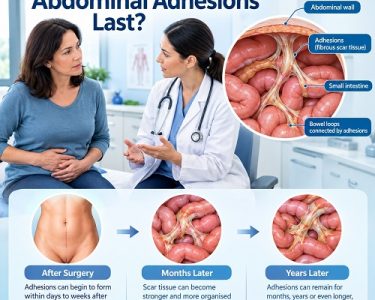
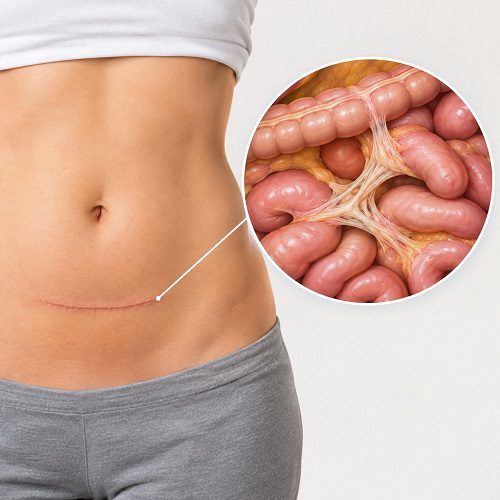
When internal tissues heal, surfaces that normally move freely against one another can sometimes become connected by bands of fibrous tissue. These bands are called abdominal adhesions.
For example, an adhesion may connect part of the intestine to another section of intestine, an abdominal organ, or the inside of the abdominal wall. In many people, these connections cause no problems. However, adhesions can sometimes pull, kink, or compress organs and tissues.
Abdominal scar tissue is therefore not necessarily a sign that something went wrong during surgery. Adhesions can be a natural consequence of the body’s healing process following abdominal injury or surgery.
Why Does Abdominal Scar Tissue Form After Surgery?
Surgery involves manipulating or cutting tissues, which naturally causes inflammation. The body responds by beginning a complex healing process.
During healing, the body produces substances and cells that repair damaged tissue. Collagen and other connective tissues help strengthen the injured area. In the abdomen, however, this healing process can occasionally cause nearby surfaces to become attached.
Abdominal surgery is the most common cause of abdominal adhesions. They can occur after both open and minimally invasive procedures, although they are generally less common after laparoscopic surgery than after open abdominal surgery.
Factors associated with a greater likelihood of adhesions include:
- Open abdominal surgery
- Multiple abdominal operations
- Emergency abdominal surgery
- Surgery involving the lower digestive tract
- Pelvic surgery
- Infection or inflammation inside the abdomen
Abdominal adhesions can also develop from conditions that cause inflammation, including certain abdominal infections, Crohn’s disease, diverticular disease, endometriosis, and other inflammatory conditions.
Abdominal Adhesions vs. a Surgical Scar
It is important to distinguish between an external surgical scar and internal abdominal scar tissue.
A surgical scar is the visible or palpable mark left on the skin after an incision heals. Its appearance can change over time, and many scars gradually become less noticeable.
Abdominal adhesions, on the other hand, are internal bands of scar-like tissue. You generally cannot see them from the outside.
A person can have a small, well-healed surgical scar on the skin while having internal adhesions. Conversely, a visible surgical scar does not automatically mean that a person has problematic internal adhesions.
This distinction is important because abdominal pain after surgery can have many possible causes, and not every symptom is caused by scar tissue.
How Common Are Abdominal Adhesions?
Abdominal adhesions are relatively common after abdominal surgery. According to the National Institute of Diabetes and Digestive and Kidney Diseases (NIDDK), adhesions develop in more than 9 out of 10 people who undergo surgery that opens the abdomen. However, most people with adhesions do not develop symptoms or complications.
This means that having abdominal scar tissue does not necessarily mean that you will have ongoing pain or digestive problems.
Some people may never know they have adhesions unless they undergo another abdominal procedure that reveals them.
What Symptoms Can Abdominal Scar Tissue Cause?
Most abdominal adhesions do not cause noticeable symptoms. When symptoms do occur, chronic abdominal pain is one of the most common complaints.
Symptoms may vary depending on where the adhesions form and whether they interfere with normal movement of the abdominal organs.
Possible Abdominal Adhesions symptoms include:
- Persistent or recurring abdominal pain
- Cramping
- A feeling of pulling or tightness in the abdomen
- Bloating
- Changes in bowel habits
- Constipation
- Nausea
- Vomiting
- Difficulty passing gas
However, these symptoms are not specific to abdominal adhesions. Conditions such as hernias, gastrointestinal disorders, infections, inflammation, and other postoperative complications can produce similar symptoms.
For this reason, ongoing or unexplained abdominal symptoms should be evaluated by a healthcare professional rather than automatically attributed to scar tissue.
Can Abdominal Scar Tissue Cause a Bowel Obstruction?
One of the most serious potential complications of abdominal adhesions is intestinal or small bowel obstruction.
An adhesion can create a band around or between sections of the intestine. In some cases, this can cause the intestine to become kinked, twisted, narrowed, or compressed.
A bowel obstruction may prevent food, liquid, gas, and stool from moving normally through the digestive tract. Adhesions are an important cause of small bowel obstruction.
Warning signs can include:
- Severe or worsening abdominal pain or cramping
- Significant abdominal swelling or bloating
- Nausea and vomiting
- Inability to pass gas
- Inability to have a bowel movement
A suspected complete bowel obstruction requires urgent medical evaluation because complications can become life-threatening.
If someone who has previously undergone abdominal surgery develops severe abdominal pain accompanied by vomiting, marked swelling, and an inability to pass stool or gas, they should seek emergency medical attention rather than waiting for the symptoms to resolve.
Can Abdominal Adhesions Develop Years After Surgery?
Yes. Problems associated with abdominal adhesions do not necessarily occur immediately after an operation.
Adhesions can cause symptoms or complications months or even years after the original surgery. This can sometimes make it difficult for a person to connect a new abdominal problem with an operation performed in the past.
For this reason, tell your healthcare provider about previous abdominal or pelvic surgeries, even if they occurred many years ago.
A history of previous surgery can provide an important clue when a doctor is evaluating unexplained abdominal symptoms.
How Are Abdominal Adhesions Diagnosed?
Diagnosing abdominal adhesions can be challenging because the adhesions themselves are often difficult to see with standard imaging tests.
Doctors generally begin by reviewing your medical history and asking about previous surgeries, illnesses, symptoms, and their timing. A physical examination may also be performed.
Blood tests may be used to look for other conditions or complications, although blood tests do not directly diagnose adhesions.
Imaging tests such as CT scans and X-rays may be useful for identifying complications such as intestinal obstruction or for ruling out other causes of abdominal pain. However, imaging usually cannot directly show uncomplicated abdominal adhesions.
In some situations, surgery may be required to confirm the presence of adhesions. Laparoscopic or open surgery allows surgeons to directly inspect the abdominal cavity and, when appropriate, treat adhesions during the procedure.
How Are Abdominal Adhesions Treated?
Abdominal Adhesions Treatment depends on whether the adhesions are causing symptoms or complications.
No Treatment May Be Necessary
If abdominal adhesions are not causing symptoms or complications, treatment is often unnecessary.
This is important because surgery to remove adhesions can itself cause new scar tissue and adhesions. Therefore, doctors generally consider the potential benefits and risks carefully before recommending an operation solely to remove scar tissue.
Adhesiolysis
When adhesions cause a significant medical problem, a surgeon may perform a procedure called adhesiolysis.
During adhesiolysis, the surgeon separates or cuts the abnormal bands of scar tissue. Depending on the situation, the procedure may be performed laparoscopically or through open surgery.
The appropriate approach depends on factors such as the location and extent of the adhesions, previous operations, the patient’s condition, and whether there is an emergency such as bowel obstruction.
It is important to understand that surgery does not guarantee that adhesions will never return. In fact, surgery itself can stimulate another healing response and lead to additional adhesions.
Can Abdominal Scar Tissue Be Prevented?
It is not always possible to prevent abdominal adhesions completely.
Surgeons can use techniques intended to reduce the likelihood of adhesion formation. Depending on the operation, these may include minimizing unnecessary tissue trauma, handling tissues carefully, reducing contamination by foreign materials, and using certain adhesion barriers when appropriate.
Laparoscopic surgery may also be associated with fewer adhesions than traditional open abdominal surgery in some circumstances. However, whether laparoscopic surgery is appropriate depends on the specific procedure and individual patient.
Patients should not assume that choosing minimally invasive surgery is always possible. The surgical approach depends on the medical condition, procedure, safety considerations, and surgeon’s judgment.
Can You Break Up Abdominal Scar Tissue Without Surgery?
People with abdominal discomfort sometimes wonder whether exercise, massage, physical therapy, special diets, or other treatments can remove internal adhesions.
Currently, there is no simple home treatment that physically removes established abdominal adhesions.
Some research has examined physical therapy and soft-tissue techniques for adhesion-related pain, but more research is needed to establish how effective these approaches are and which patients may benefit.
If you have persistent abdominal pain after surgery, it is better to discuss the symptoms with a qualified healthcare professional before attempting aggressive abdominal massage or other treatments.
Does Diet Affect Abdominal Adhesions?
There is no universal diet that removes or dissolves abdominal adhesions.
If adhesions have caused or contributed to a bowel obstruction, dietary recommendations may depend on the severity and nature of the obstruction and should come from your healthcare team.
Some people with specific bowel problems may be advised to modify the texture or fiber content of their diet, but this is not the same as treating the underlying adhesion.
Avoid making major dietary restrictions based solely on the assumption that abdominal scar tissue is responsible for your symptoms.
When Should You See a Doctor?
Not every abdominal symptom after surgery is an emergency, but persistent or unexplained symptoms deserve medical attention.
Contact your healthcare provider if you experience recurring abdominal pain, unexplained bloating, ongoing changes in bowel habits, or difficulty passing stool or gas.
Seek urgent medical attention if you develop symptoms that could indicate an intestinal obstruction, particularly severe abdominal pain, substantial abdominal swelling, persistent vomiting, or an inability to pass gas or stool.
Prompt evaluation is especially important for people with a history of abdominal surgery because adhesions can sometimes cause bowel obstruction even years after an operation.
Living With Abdominal Scar Tissue
For many people, living with abdominal scar tissue does not require any special treatment. Adhesions are common, and most do not cause symptoms or complications.
If you have been diagnosed with abdominal adhesions, the most important step is to understand what symptoms you should monitor and when to seek medical care.
Keep your healthcare providers informed about previous abdominal surgeries and any significant changes in your digestive or abdominal symptoms. If symptoms develop, your doctor can determine whether adhesions are a likely explanation or whether another condition needs to be investigated.
It is also important not to assume that all postoperative abdominal pain is caused by adhesions. A careful medical assessment is necessary because many different conditions can produce similar symptoms.
Final Thoughts
Abdominal scar tissue is a common part of the body’s healing response after abdominal surgery. When internal scar tissue forms bands that connect organs or tissues, these bands are known as abdominal adhesions or surgical adhesions.
Most adhesions never cause symptoms and do not require treatment. However, in some people they can contribute to chronic abdominal pain or serious complications such as intestinal obstruction.
Because adhesions can be difficult to identify with routine imaging, doctors typically consider a patient’s surgical history, symptoms, examination findings, and other test results when evaluating possible adhesion-related problems.
If you have persistent abdominal symptoms following surgery—or develop severe pain, vomiting, significant swelling, or an inability to pass gas or stool—contact a healthcare professional promptly. Early evaluation can help identify complications and determine the most appropriate treatment.
Medical disclaimer: This article is intended for general educational purposes and does not replace professional medical advice, diagnosis, or treatment. If you have concerning symptoms after surgery, consult a qualified healthcare professional or seek emergency care when appropriate.