
 By
By Swallowing is something most of us do hundreds of times a day without even thinking about it. From sipping water to enjoying a full meal, the process feels effortless—until something goes wrong. For individuals living with achalasia, swallowing can become a daily struggle marked by discomfort, anxiety, and uncertainty. The phrase achalasia difficulty swallowing captures one of the most common and distressing symptoms of this rare esophageal disorder.
We will explore why achalasia causes difficulty swallowing, what happens inside the body, how the condition develops, and what can be done to manage it. By understanding the underlying mechanisms of dysphagia in achalasia, patients and caregivers can make informed decisions about diagnosis and treatment.
You can also visit to our product page for exploring and buying the herbal made supplements for achalasia.
Understanding Achalasia: A Brief Overview
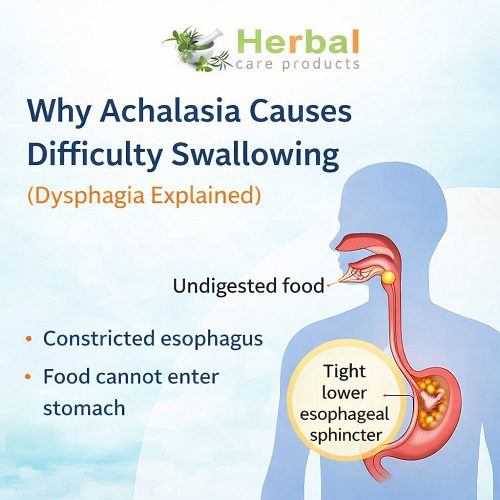
Achalasia is a rare disorder of the esophagus, the muscular tube that carries food and liquids from the mouth to the stomach. In people with achalasia, two major problems occur:
- The lower esophageal sphincter (LES)—a ring of muscle at the bottom of the esophagus—fails to relax properly.
- The normal wave-like muscle contractions (peristalsis) that move food down the esophagus are absent or severely impaired.
Because of these issues, food and liquids have difficulty passing into the stomach. Over time, the esophagus may become stretched and enlarged due to retained material.
The result? Persistent and progressive difficulty swallowing, also known as dysphagia.
What Is Dysphagia?
Dysphagia is the medical term for difficulty swallowing. It can affect:
- The initiation of swallowing (oropharyngeal dysphagia)
- The movement of food through the esophagus (esophageal dysphagia)
In achalasia, the problem is primarily esophageal. Patients often describe:
- Feeling like food is “stuck” in the chest
- Regurgitation of undigested food
- Chest discomfort after eating
- Difficulty swallowing both solids and liquids
Unlike many other causes of dysphagia that begin with difficulty swallowing solids only, achalasia typically affects both solids and liquids from the early stages.
The Normal Swallowing Process
To understand why achalasia difficulty swallowing occurs, it’s important to first understand how swallowing normally works.
Swallowing is a coordinated process involving:
- Oral phase – Food is chewed and formed into a bolus.
- Pharyngeal phase – The bolus is pushed into the throat.
- Esophageal phase – Muscular contractions move the bolus down the esophagus toward the stomach.
During the esophageal phase:
- The upper esophageal sphincter opens to allow entry into the esophagus.
- Peristaltic waves push the food downward.
- The lower esophageal sphincter relaxes at the right moment.
- Food enters the stomach.
- The LES then tightens again to prevent reflux.
This sequence depends on a highly coordinated network of nerves and muscles. When this coordination fails, swallowing becomes difficult.
What Goes Wrong in Achalasia?
In achalasia, the nerves that control the esophageal muscles and lower esophageal sphincter become damaged. Specifically, inhibitory nerve cells in the esophageal wall degenerate.
This nerve damage leads to two main problems:
1. Failure of the Lower Esophageal Sphincter to Relax
The LES is supposed to relax when you swallow. In achalasia, it remains tightly closed or only partially relaxes.
This creates a functional obstruction at the junction between the esophagus and stomach. Food reaches the bottom of the esophagus but cannot easily pass through.
Imagine a door that refuses to open fully—you can push against it, but progress is limited.
2. Loss of Peristalsis
Normally, the esophagus generates coordinated waves that propel food downward. In achalasia, these waves are absent or replaced with weak, uncoordinated contractions.
Without peristalsis:
- Food does not move efficiently.
- Gravity becomes the primary means of transport.
- Material accumulates in the esophagus.
Together, these abnormalities explain why achalasia difficulty swallowing is progressive and persistent.
Why Achalasia Causes Difficulty Swallowing (Step-by-Step)
Let’s break down the process in detail.
Step 1: Food Enters the Esophagus
The oral and throat phases of swallowing are usually normal in achalasia. Food enters the esophagus without issue.
Step 2: Lack of Coordinated Contractions
Once inside the esophagus, the normal peristaltic wave fails to occur. Instead of a smooth push downward, the food remains in place or moves sluggishly.
Step 3: Resistance at the LES
When food reaches the lower esophageal sphincter, it encounters a muscle that does not relax properly. This creates resistance.
Step 4: Food Retention and Backflow
Because the LES does not open adequately:
- Food builds up in the esophagus.
- Pressure increases.
- Some food may flow back upward (regurgitation).
Step 5: Esophageal Dilation
Over time, repeated retention stretches the esophagus. The enlarged esophagus becomes less efficient, worsening swallowing difficulties.
This progressive cycle is central to achalasia difficulty swallowing.
Why Both Solids and Liquids Are Affected
In many mechanical obstructions—such as tumors or strictures—patients initially have difficulty swallowing solids but not liquids.
Achalasia is different because it is a motility disorder rather than a structural blockage.
Since peristalsis is absent and the LES fails to relax:
- Solids cannot be pushed down.
- Liquids also cannot pass freely.
This is why early involvement of both solids and liquids is a hallmark of achalasia.
Types of Achalasia and Their Impact on Swallowing
Modern diagnostic tools have identified different subtypes of achalasia, based on esophageal pressure patterns.
Type I (Classic Achalasia)
- Minimal esophageal pressurization
- Poor muscle activity
- Severe difficulty swallowing
Type II
- Some pressurization within the esophagus
- Often responds best to treatment
- Dysphagia still prominent
Type III (Spastic Achalasia)
- Spastic, abnormal contractions
- Significant chest pain
- Dysphagia combined with painful swallowing
Each subtype results in achalasia difficulty swallowing, though the exact sensations may differ.
Why Symptoms Worsen Over Time
Achalasia is typically progressive. As nerve damage continues:
- The LES becomes more dysfunctional.
- The esophagus stretches further.
- Muscle tone weakens.
This progression explains why many patients report that swallowing problems gradually become more frequent and severe.
Without treatment, advanced achalasia can lead to:
- Severe malnutrition
- Significant weight loss
- Aspiration (food entering the lungs)
Common Symptoms Associated with Achalasia Difficulty Swallowing
Dysphagia rarely occurs in isolation. Other symptoms often accompany it.
1. Regurgitation
Undigested food may come back up, sometimes hours after eating.
2. Chest Pain
Increased pressure in the esophagus can cause discomfort or spasms.
3. Heartburn-Like Symptoms
Though not true acid reflux, food retention may cause burning sensations.
4. Coughing or Aspiration
Regurgitated food can enter the airway, especially at night.
5. Weight Loss
Reduced intake and inefficient swallowing contribute to unintended weight loss.
These symptoms collectively stem from the same underlying issue: impaired esophageal motility and LES dysfunction.
The Role of the Nervous System
The esophagus relies on a complex network of nerves known as the enteric nervous system.
In achalasia:
- Inhibitory neurons degenerate.
- The balance between contraction and relaxation is disrupted.
- The LES remains overly tight.
The exact cause of this nerve damage is not fully understood, but possible contributing factors include:
- Autoimmune processes
- Viral infections
- Genetic susceptibility
Regardless of the trigger, the outcome is the same: persistent achalasia difficulty swallowing.
How Achalasia Is Diagnosed
When patients report progressive dysphagia affecting solids and liquids, doctors may recommend several tests.
1. Esophageal Manometry
This is the gold standard test. It measures:
- Muscle contractions
- LES pressure
- Relaxation response during swallowing
Manometry confirms the absence of peristalsis and incomplete LES relaxation.
2. Barium Swallow Study
Patients swallow a contrast liquid, and X-rays show:
- Dilated esophagus
- Narrowed lower esophagus (often described as a “bird’s beak” appearance)
3. Endoscopy
Used to rule out other causes such as tumors or strictures.
These diagnostic tools help confirm that achalasia difficulty swallowing is due to a motility disorder rather than a structural blockage.
Why Achalasia Is Often Misdiagnosed
Early symptoms can resemble:
- Gastroesophageal reflux disease (GERD)
- Anxiety-related swallowing issues
- Esophageal spasms
Because achalasia is rare, diagnosis is sometimes delayed. Patients may initially receive acid-suppressing medications that do not improve symptoms.
Persistent dysphagia, especially involving liquids, should prompt further evaluation.
Treatment Options for Achalasia Difficulty Swallowing
Although achalasia cannot currently be cured, treatments aim to reduce LES pressure and improve swallowing.
1. Pneumatic Dilation
A balloon is inserted and inflated to stretch the LES.
- Minimally invasive
- May require repeat procedures
- Can significantly reduce dysphagia
2. Surgical Myotomy
A surgeon cuts the LES muscle to allow food to pass more easily.
- Often performed laparoscopically
- Provides long-term relief
3. Peroral Endoscopic Myotomy (POEM)
A minimally invasive endoscopic procedure.
- No external incisions
- Increasingly popular
- Effective for various achalasia types
4. Botulinum Toxin Injections
Botox relaxes the LES temporarily.
- Short-term solution
- Often used in patients who cannot undergo surgery
All treatments aim to address the mechanical resistance at the LES, thereby reducing achalasia difficulty swallowing.
Lifestyle Adjustments to Ease Swallowing
While medical treatment is essential, certain strategies may help manage symptoms:
- Eating slowly
- Taking small bites
- Drinking water with meals
- Remaining upright after eating
- Avoiding meals before bedtime
These measures do not fix the underlying issue but may reduce discomfort.
Potential Complications of Untreated Achalasia
Without intervention, achalasia may lead to:
- Severe esophageal dilation (megaesophagus)
- Chronic aspiration
- Recurrent pneumonia
- Malnutrition
- Increased risk of esophageal cancer (rare but notable)
Early diagnosis and treatment significantly reduce these risks.
The Emotional Impact of Chronic Dysphagia
Living with achalasia difficulty swallowing can be emotionally taxing.
Patients often experience:
- Anxiety about eating in public
- Fear of choking
- Social withdrawal
- Frustration over delayed diagnosis
Understanding the condition empowers patients and reduces uncertainty.
Can Achalasia Be Prevented?
Currently, there is no known way to prevent achalasia because its exact cause remains unclear.
However, early recognition of symptoms allows for timely intervention, preventing severe complications.
Key Takeaways
To summarize why achalasia causes difficulty swallowing:
- Nerve damage disrupts esophageal muscle function.
- The lower esophageal sphincter fails to relax properly.
- Peristalsis is absent or abnormal.
- Food accumulates in the esophagus.
- Swallowing becomes progressively more difficult.
The term achalasia difficulty swallowing reflects the core mechanism of this disorder: impaired muscle coordination and a non-relaxing sphincter.
Final Thoughts
Swallowing is a complex, finely tuned process that depends on seamless coordination between nerves and muscles. In achalasia, this coordination breaks down. The lower esophageal sphincter remains tight, peristaltic waves disappear, and food struggles to reach the stomach.
The result is persistent dysphagia that affects both solids and liquids—a defining feature of achalasia.
Although the condition is chronic, modern treatments offer effective symptom relief and improved quality of life. With proper diagnosis and management, individuals with achalasia can regain confidence in eating and reduce the burden of daily swallowing difficulties.
If you or someone you know experiences progressive difficulty swallowing, particularly with both solids and liquids, seeking medical evaluation is essential. Early diagnosis can prevent complications and restore comfort during one of life’s most basic functions: eating.